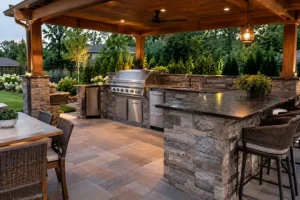
A well-designed outdoor kitchen can help you enjoy your backyard long after summer ends. To create a comfortable fall gathering area, outdoor kitchen services bring together cooking equipment, counter space, lighting, drainage, seating, and weather protection.
The best results come from planning the whole space—not simply installing a grill. Whether you want a compact patio kitchen or a larger entertaining area, this guide explains what to prioritize, how to compare installers, and how to protect your investment as temperatures drop.
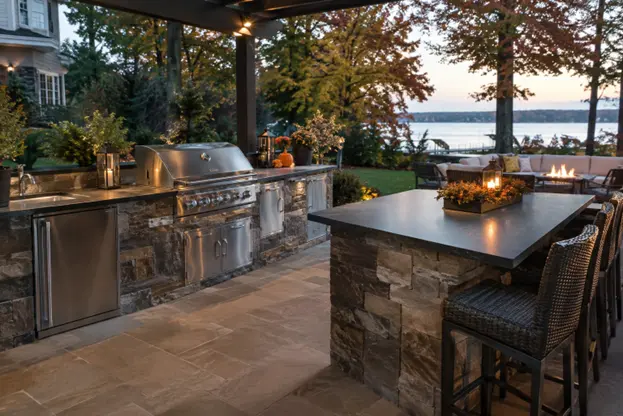
How Outdoor Kitchen Services Help Extend the Fall Season
Cooler evenings make outdoor cooking especially appealing. The intense heat of summer has passed, seasonal meals feel right outside, and gathering around a dining table or lounge area becomes more comfortable.
An outdoor kitchen also keeps the cook involved. Instead of preparing food indoors while guests wait on the patio, you can grill, assemble dishes, and serve drinks within the gathering space. That connection is often more valuable than adding numerous appliances.
However, extending the outdoor season requires realistic expectations. A roof, heater, or weather-resistant refrigerator does not automatically make a kitchen suitable for every winter condition. Plumbing, appliances, ventilation, and structural details must match the location and intended use.
Start With Your Entertaining Habits
Before selecting equipment, consider how you actually cook. A household that grills twice a week may benefit most from a dependable grill, generous preparation counter, and nearby dining table. Frequent hosts may need additional serving space, refrigeration, storage, and separate guest circulation.
Write down your typical gathering size and favorite meals. Think about whether you serve full dinners, casual snacks, weekend breakfasts, or holiday gatherings. These answers help prevent spending money on equipment that looks impressive but rarely gets used.
For example, a homeowner who enjoys autumn pizza nights might prioritize an approved pizza oven and preparation surface over an outdoor dishwasher. Someone hosting football afternoons may find beverage storage and buffet space more useful.
Improve An Existing Patio First
You do not always need a complete rebuild. An existing patio may already have enough space for a compact cooking station, improved lighting, a serving cart, and weather-ready furniture.
Start by checking its condition. Look for uneven paving, standing water, poor access from the house, and insufficient room around furniture. Correct those problems before adding permanent cabinets or appliances.
A contractor offering outdoor kitchen services should explain whether the existing surface can support the proposed kitchen or whether additional foundation work is needed. Large masonry islands and lightweight modular units create different construction demands.
What Outdoor Kitchen Services Include
Outdoor kitchen services can cover design, site preparation, construction, appliance installation, utility coordination, lighting, and seasonal maintenance. The exact scope varies by contractor, so ask what is included and which tasks require separate licensed trades.
A complete project should coordinate the kitchen with the patio rather than treating them as unrelated installations. Counters, appliances, paths, drainage, seating, and service access all need to work together.
Site Evaluation And Design
A useful consultation begins with measurements and questions. The designer should assess access from the house, wind exposure, sunlight, existing drainage, nearby windows, overhead structures, and available utility connections.
The plan should show appliance locations, preparation surfaces, cabinet openings, seating, and walking routes. It should also account for manufacturer-required clearances before the layout is finalized.
Early utility and ventilation planning matters because changing gas lines, duct routes, electrical circuits, or drainage after construction can be disruptive. Outdoor kitchen planning guidance recommends resolving those systems before cabinetry and countertops are installed.
Choose A Practical Layout
The right kitchen shape depends on usable patio space—not just the size of the yard. A large backyard can still have a narrow patio, while a compact property may accommodate a well-organized island.
Layout | Best application | Main planning concern |
Linear | Small patios and straightforward grill stations | Providing enough preparation and serving space |
L-shaped | Medium patios with separate cooking and serving areas | Keeping corner storage accessible |
U-shaped | Larger, dedicated outdoor kitchens | Preserving comfortable interior circulation |
Island | Open patios with social seating | Separating guests from hot appliances |
Modular | Phased projects and flexible configurations | Coordinating foundations, connections, and appliance compatibility |
Avoid choosing a larger footprint simply because space exists. A compact kitchen with good storage and useful counters often works better than a sprawling layout requiring constant movement.
Place The Kitchen Near Useful Connections
A convenient location reduces trips indoors for food, dishes, and supplies. Close access to the indoor kitchen can be particularly helpful during fall gatherings when guests may move between inside and outside.
Convenience must not override safety. Consider smoke entering nearby doors or windows, roof overhangs above the cooking area, and combustible walls or furniture.
The International Code Council emphasizes using tested and listed appliances, following installation instructions, and observing clearances when designing outdoor kitchens. It specifically identifies roof overhangs and covered grilling areas as details requiring attention.
Select Appliances Intentionally
Start with the cooking equipment you will use most. A grill is often the foundation, but a side burner, smoker, griddle, or pizza oven may be worthwhile if it matches your meals.
Choose appliances rated for outdoor use. Also check operating-temperature limits, required ventilation, fuel connections, servicing access, and winter-storage instructions.
Do not assume every built-in grill can be placed inside any cabinet system. Some installations require specified insulation, ventilation, or construction details. Appliance specifications should guide the island—not the other way around.
Plan Useful Counter Space
Counters need to accommodate food preparation, serving dishes, utensils, and safe placement of items near cooking equipment. A kitchen that has a premium grill but almost no landing space is inconvenient.
Separate raw-food preparation from finished-food serving wherever practical. Keep a clear area for hot cookware, and ensure guests do not need to reach across the cooking zone for drinks or snacks.
Mock up the layout before construction. Set folding tables or cardboard templates where counters will go, then rehearse preparing and serving a typical meal. This reveals awkward arrangements that a drawing may not make obvious.
Decide Whether A Sink Is Necessary
An outdoor sink can simplify food preparation and cleanup, but it adds water-supply, wastewater, and freeze-protection requirements. It is not automatically essential for a useful patio kitchen.
Ask the contractor how the sink will drain and how its water lines will be isolated and winterized. Do not approve a vague plan that releases wastewater into the yard without confirming local requirements.
ICC guidance notes that freeze-prone outdoor water service may be designed with an indoor shutoff and drainable exterior piping. That approach must still be specified for the particular installation.
Coordinate Electrical And Gas Work
Refrigeration, lighting, outlets, ignition systems, and electric cooking appliances may have different electrical demands. Natural-gas equipment also requires correctly planned piping and accessible shutoffs.
Have qualified professionals determine the necessary circuits, protection, connections, and permits. A nearby outlet does not prove that the kitchen’s electrical needs are covered.
Keep service access visible in the plans. Gas valves, electrical components, and plumbing connections should remain reachable after cabinets and stonework are completed. Outdoor-kitchen safety guidance stresses accessible gas shutoffs and suitable outdoor appliances.
Make the Space Fall-Friendly
A fall-ready kitchen needs more than cooking equipment. Comfort comes from shelter, seating, lighting, circulation, and a layout that makes the backyard pleasant after sunset.
Add Appropriate Weather Protection
A pavilion, covered patio, pergola, or retractable system can improve comfort, but each offers different protection. An open pergola filters sunlight; a solid roof provides overhead shelter but creates additional ventilation considerations.
Do not assume that open sides make any covered grill installation acceptable. Confirm that the appliance permits the proposed location, then evaluate exhaust, clearances, and surrounding materials.
For covered patios, outdoor kitchen services may include professional ventilation planning for an outdoor-rated hood, properly routed ductwork, and adequate replacement airflow. Resolve these details before the roof and grill island locations become fixed.
Separate Warmth From Cooking
The grill should not be treated as a patio heater. Plan comfort heating independently so guests can relax without gathering around hot cooking surfaces.
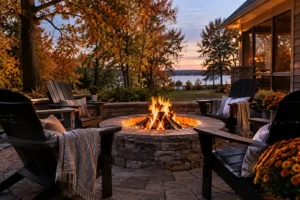
An approved electric heater, propane heater, or nearby fire feature may be an option, depending on the space. Each requires its own clearances, ventilation, mounting, and operating instructions.
Keep heating away from loose fabric, curtains, cushions, and traffic routes. If the covered area cannot accommodate safe heating, create a separate open-air lounge instead.
Layer The Lighting
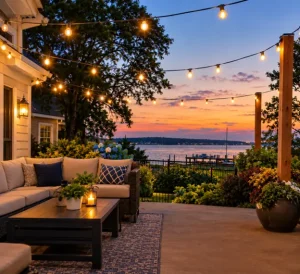
Shorter fall days make lighting essential. Use focused task lighting over preparation surfaces and cooking equipment, then softer ambient lighting around dining and seating.
Path and step lights should reveal routes to the house and changes in elevation. Accent lighting can highlight nearby trees, planters, or stone walls without illuminating every corner.
Control zones separately when possible. You may want bright preparation light while cooking, lower dining light during the meal, and gentle path lighting afterward. This flexibility makes the kitchen more comfortable than a single bright floodlight.
Keep Guests Outside The Work Zone
A social kitchen should encourage conversation without drawing people into the cooking path. Position bar seating, beverage service, and snack stations where guests can participate safely.
A separate drink counter can prevent repeated refrigerator access from interrupting the cook. Likewise, locate the dining table close enough for serving but outside cabinet-door swings and appliance clearances.
Preserve a route from the patio door to the yard that does not pass directly behind the grill operator. Children and pets should remain away from active cooking equipment, and appliances should never be left unattended.
Choose Comfortable Furniture
Outdoor furniture should suit the weather exposure, storage options, and available space. Select dining chairs people can use comfortably for longer meals rather than choosing appearance alone.
Keep loose cushions and blankets in dry storage when not needed. A roof reduces direct rainfall, but wind-driven moisture and damp conditions can still affect furnishings.
Built-in seating can provide overflow capacity, while movable chairs allow different group sizes. Avoid filling the patio so densely that the kitchen becomes difficult to access.
Connect The Kitchen To The Garden
Planting softens cabinetry and paving, making the kitchen feel part of the backyard. Use containers, low shrubs, grasses, or perennial borders without blocking clearances and maintenance access.
Herb planters can be useful near a serving area, provided they stay away from heat and smoke. Seasonal containers can add autumn color without requiring a full garden redesign.
Repeat materials and colors already present in the landscape. A stone-faced island, coordinated path, and restrained planting palette usually feel more cohesive than several unrelated finishes.
Choose Durable Materials and Construction
An outdoor kitchen must withstand moisture, sun, temperature changes, cooking spills, and cleaning. Beyond attractive finishes, outdoor kitchen services should address foundation quality and water management.
Build On A Suitable Foundation
Before installing the kitchen, determine how its weight will be supported. A heavy masonry structure may require construction different from a modular cabinet arrangement.
Inspect the existing patio for settlement, cracking, and drainage issues. Do not place permanent equipment over a failing surface and expect the kitchen to stabilize it.
Discuss excavation, support, reinforcement where necessary, and access for future repairs. Construction specifications should match the actual system and local site conditions.
Protect The Kitchen From Runoff
Water should not collect beneath appliances, inside cabinets, or against the house. Evaluate patio slope, downspout discharge, roof runoff, and nearby low spots.
A drainage correction may be necessary before installation. Depending on the site, that could involve regrading, a channel drain, a swale, or another professionally designed solution.
Decorative gravel alone is not a complete drainage plan. Ask where water will go during heavy rain and whether the installation changes runoff elsewhere on the property.
Compare Finishes By Function
Choose countertops rated for the intended exterior exposure. Confirm suitability for freezing conditions, heat, stains, and manufacturer-recommended maintenance.
Outdoor cabinets likewise need more than an exterior appearance. Doors, hinges, fasteners, finishes, and internal construction should be designed for the environment.
Component | What to verify |
Countertop | Exterior suitability, weather resistance, cleaning instructions |
Cabinets | Outdoor rating, corrosion resistance, ventilation requirements |
Grill island | Appliance compatibility, approved construction, access panels |
Patio surface | Stable support, traction, drainage, repairability |
Covers | Correct fit, suitable material, manufacturer guidance |
Avoid assuming all stone requires sealing or that every countertop tolerates hot cookware. Follow material-specific instructions.
Budget For The Complete Project
Installation cost includes more than appliances and visible cabinets. Site preparation, foundations, utility runs, ventilation, electrical work, drainage, permits, and restoration can substantially affect the proposal.
Compare estimates using the same scope. A cheaper quote may omit important systems rather than offer better value.
A phased project can help manage spending. Build a dependable grill, counter, and storage arrangement first, but plan approved future utility routes before paving and finishes make changes difficult.
Hire Locally and Prepare for Winter
Evaluate Local Installers Carefully
When searching for “outdoor kitchen installation near me,” look beyond advertisements and attractive photos. Choose a contractor who offers outdoor kitchen services, has relevant experience, and follows a clear process for coordinating regulated trades.
Review projects similar in size and complexity to yours. Ask how the company handled ventilation, drainage, utility access, and winter maintenance—not just which grill it installed.
Verify required credentials and insurance with the relevant authorities or providers. Request a written scope, material specifications, payment milestones, estimated schedule, exclusions, and warranty terms.
Ask For A Realistic Fall Schedule
Fall construction depends on weather, permit processing, inspections, material availability, and trade coordination. A contractor should explain those dependencies instead of promising completion without assessing the site.
Ask which stages must occur in suitable temperatures and what happens if prolonged rain interrupts excavation or finishing.
If the full project cannot be completed safely before winter, finish design and approvals rather than rushing construction. A well-planned later installation is preferable to shortcuts made for a seasonal deadline.
Winterize Water-bearing Components
Extending fall use does not mean leaving water systems active through freezing weather. Sinks, ice makers, refrigerators with water connections, and other plumbing components need a specific shutdown plan.
Outdoor cabinet manufacturer Danver recommends isolating and draining water supplies, including lines connected to sinks, refrigerators, and ice makers. Appliance instructions remain essential because systems differ.
Schedule service before freezing conditions arrive. Do not rely on insulation alone to protect water trapped inside plumbing.
Maintain Appliances Between Gatherings
Clean cooking surfaces and grease trays, remove food debris, and inspect accessible components according to manufacturer instructions. A clean grill reduces grease-related flare-up risks.
Use properly fitted covers where recommended, but allow equipment to cool and dry before covering. Follow refrigerator operating limits and shutdown procedures rather than assuming an outdoor-rated appliance can run in every temperature.
Keep leaves away from vents, drains, and cooking equipment. Regular attention makes the kitchen easier to use throughout autumn and reduces spring cleanup.
Make the Most of Fall with Outdoor Kitchen Services
A successful outdoor kitchen brings cooking, dining, and conversation together without compromising safety or comfort. Start with a practical layout, dependable preparation space, appropriate appliances, clear circulation, and a plan for lighting, ventilation, drainage, and cold-weather care.
Ready to create a beautiful fall gathering space? Contact Hawkins Landscaping Inc. for professional outdoor kitchen services and customized patio kitchen planning tailored to your home, yard, and budget.
When comparing “outdoor kitchen installation near me” providers, it’s important to consider the complete project, including construction, utilities, permits, material selection, drainage, and maintenance. Our team can help coordinate your patio kitchen with surrounding patios, walkways, landscape lighting, and other outdoor features to create a cohesive and functional space.
With over 50 years of experience serving Frederick County and surrounding areas, Hawkins Landscaping Inc. can help you create a welcoming destination for autumn meals, weekend entertaining, and relaxing outdoor evenings—with thoughtful planning to make seasonal winter preparation easier.
Ready to upgrade your outdoor living space? Call (301) 898-3615 or visit hawkinslandscaping.com to schedule your consultation. Ask about our flexible financing options for your outdoor project.