Keeping water away from your house requires effective landscaping and maintenance. A successful plan addresses three priorities: managing roof runoff, maintaining ground that directs water away from the foundation, and giving collected water an appropriate destination. Plants, mulch, decorative stone, and drains can support that plan, but none should be installed without understanding how water moves across the property.
These features work together as a system. Gutters, downspouts, garden beds, paving, soil, and drainage features all influence where rainwater goes.
This guide explains how to identify problems, compare drainage approaches, select landscaping materials, and maintain improvements. You will also find landscaping ideas that combine useful stormwater management with an attractive yard.
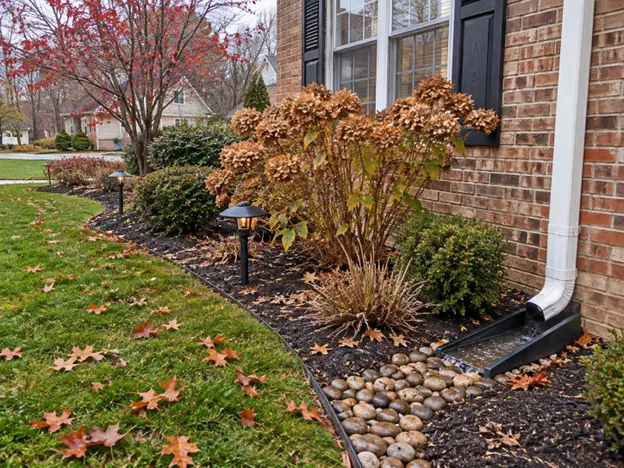
Start Your Landscaping and Maintenance Plan by Finding the Water Source
Before buying pipe or ordering soil, determine where the water originates.
Possible sources include roof runoff, uphill drainage, nearby paving, irrigation, and naturally slow-draining soil. More than one may affect the same area.
University of Maryland Extension explains that construction, additions, and landscaping changes can increase or redirect stormwater. It cautions that improvised fixes, including trenches and blocked drainage routes, can worsen conditions for neighboring properties.
Observe the site during rainfall when safe. Photograph flowing water, overflowing gutters, puddles, and sediment trails.
Record when indoor dampness appears, if present, but do not assume all moisture has an outdoor drainage cause.
A clear diagnosis is essential when planning landscaping and maintenance because it helps distinguish routine upkeep from a problem requiring a drainage, building-envelope, plumbing, or structural specialist.
1. Inspect Gutters Before Changing the Landscape
A landscape project can miss the problem if roof runoff is not checked first.
As part of routine landscaping and maintenance, inspect gutters from a safe location for visible debris, overflow, disconnected sections, or water spilling near the foundation. Arrange professional access where necessary rather than climbing onto an unsafe roof or ladder.
University of Maryland Extension recommends keeping gutters clean to promote drainage and maintaining ground that directs water away from the foundation.
After cleaning or repair, observe the system during another rainfall.
If overflow continues, have the gutter configuration and condition evaluated. Do not automatically compensate by adding a drain below a gutter that is not functioning correctly.
Solving the source may reduce the amount of work needed at ground level.
2. Direct Downspouts to a Suitable Destination
A downspout collects water from a roof and concentrates it at its outlet. That outlet needs deliberate placement.
University of Maryland Extension recommends redirecting runoff toward suitable permeable areas, including yards, conservation landscapes, or properly designed rain gardens, instead of sending it across hard surfaces.
Its Bay-Wise guidance recommends directing discharge at least 10 feet from the house to help avoid foundation and wet-basement problems. That distance is guidance—not proof that every discharge location will work.
Consider slope, soil, neighboring properties, and overflow.
Do not extend a downspout to a location that sends water back toward the building, across a walking route, or onto another property.
Buried connections also need a maintainable, appropriate outlet.
3. Check the Ground Around the Foundation
Walk the perimeter of the house after rainfall. Look for low areas, soil settlement, and beds that channel water toward the building.
Good landscaping and maintenance help ensure the ground directs water away from the foundation rather than allowing runoff to collect against it. University of Maryland Extension specifically recommends modifying grades where needed to direct water away.
However, regrading is not simply a matter of adding topsoil.
Have a qualified professional assess the available elevations, building details, neighboring land, and drainage destination. Avoid burying siding, ventilation openings, or other components that require clearance.
A narrow side yard may need a carefully coordinated solution rather than a steep mound of soil.
The design should show where water goes after it leaves the immediate foundation area.
4. Understand Why the Soil Drains Slowly
Water may collect because of clay-rich soil, compaction, a restrictive layer, or a high water table.
University of Maryland Extension identifies these as possible causes of slow drainage and emphasizes that soil texture and soil structure are different. You generally cannot change the soil’s basic texture, but you can improve its structure for plant growth.
A simple drainage test can help with planting decisions, but it is not a complete engineering assessment for a foundation, dry well, or infiltration system.
Do not assume adding sand will fix clay soil. The university generally discourages that approach.
Likewise, improving a planting bed with organic matter does not automatically resolve water pressure or drainage problems affecting a building.
Match the investigation to the risk.
5. Use Swales Only With a Defined Route
A shallow, landscaped channel can sometimes guide surface runoff toward an approved destination.
The important questions are where the water enters, how it moves, and where it ends.
Do not dig a trench merely because it appears to point downhill. University of Maryland Extension warns that small trenches and other unplanned changes can redirect runoff in ways that create problems for adjacent landowners.
Have the route evaluated for erosion, maintenance, access, and downstream effects.
A swale may be planted or finished differently according to its function, but appearance comes after hydraulic performance.
Keep it clear of accumulated soil and debris. A channel that gradually fills or becomes blocked no longer performs as designed.
6. Know When a French Drain Is Appropriate
“French drain” is often used as a general label for drainage work, but it is not a universal answer.
Before approving one, ask what water it is intended to collect: surface runoff, water moving through soil, or another specific source.
The contractor should explain the pipe arrangement, depth, surrounding materials, maintenance access, and discharge.
A drain without a suitable destination is incomplete.
University of Maryland Extension notes that persistent runoff problems sometimes require professional assessment to distinguish whether drains or other landscape changes are appropriate.
Avoid accepting a proposal based only on the number of feet of pipe.
The useful measure is whether the system addresses the diagnosed problem without creating another one.
7. Consider a Rain Garden in the Right Location
A rain garden can capture and temporarily hold runoff so it can soak into suitable soil.
However, it should not be installed directly beside the foundation or placed automatically in the wettest spot in the yard.
University of Maryland Extension recommends locating rain gardens downslope from contributing surfaces and at least 10 feet from dwelling foundations. It also identifies separation requirements from wells and septic drain fields.
Its additional guidance recommends greater separation when a rain garden is uphill from a building and warns against locations that remain soggy for days.
Assess soil, contributing area, overflow, and site constraints before excavation.
A rain garden is a designed stormwater feature—not simply a depression filled with moisture-tolerant plants.
8. Treat Dry Wells and Infiltration Features as Designed Systems
An underground storage or infiltration feature may be useful on a suitable site, but it needs assessment.
Soil permeability, groundwater conditions, nearby structures, utilities, and available overflow all matter.
University of Maryland Extension notes that clay-rich or compacted soil can substantially reduce infiltration performance.
Do not assume that filling a hole with gravel creates a dependable drainage solution.
Ask the designer to explain capacity, setbacks, soil suitability, maintenance, and what happens when the system fills.
Where infiltration is unsuitable, a different approach may be needed.
Do not excavate until underground utilities have been appropriately identified and applicable approvals have been addressed.
The installation should fit the site rather than force the site to fit a standard product.
9. Use Plants to Support Water Management
Planting can improve a drainage-conscious landscape, but plants cannot substitute for every necessary repair.
Choose species according to light, moisture, mature size, and the intended function of the area.
University of Maryland Extension recommends moisture-tolerant groundcovers for some naturally damp locations instead of automatically changing the entire drainage pattern.
That approach is different from leaving water against a house.
A remote wet planting area may be manageable through plant selection, while water entering a building requires direct investigation.
Keep downspout outlets from overwhelming plants that cannot tolerate saturated roots. The university notes that concentrated roof discharge can damage moisture-sensitive shrubs and may need redirection.
Use planting where it supports the water-management plan.
10. Choose Landscaping Materials by Function
Choosing suitable materials is an important part of landscaping and maintenance; select them for their function, not simply because they look clean in a photograph.
Material | Potential Role | Important Limitation |
Suitable grading soil | Establishing planned ground elevations | Must not obstruct building clearances or redirect problems |
Specified aggregate | Part of a designed drainage assembly | Decorative gravel alone does not create drainage |
Mulch | Soil cover and planting-bed management | Excessive placement can alter surface flow |
Erosion-control products | Protecting vulnerable areas during establishment | Must suit the slope and water conditions |
Drainage pipe and fittings | Conveying collected water | Requires an appropriate outlet and maintenance plan |
Plants and groundcovers | Protecting and organizing landscape areas | Must match actual soil moisture |
Permeable paving system | Managing some paved-area runoff | Requires suitable design and ongoing care |
Soil conditions remain fundamental. Organic matter can improve soil structure, but it does not make every location suitable for infiltration.
11. Do Not Rely on a Gravel Border Alone
A strip of decorative stone beside the house can look tidy, but its appearance does not establish that water is moving away.
Before installing it, ask what lies below, how the surface is graded, and where runoff will go.
Stone can be part of a designed assembly. It can also conceal a low area if installed without investigation.
The same caution applies to edging. A raised border may unintentionally interrupt surface flow.
University of Maryland Extension emphasizes understanding runoff before making changes because even seemingly small alterations can redirect water.
Choose the finish after the drainage function is clear.
A neat border should reveal and support the intended system, not hide an unresolved problem.
12. Review Patios, Walkways, and Driveways
Hard surfaces influence the volume and direction of runoff.
Inspect where paving meets the house, steps, planting beds, and downspout outlets. Look for settlement or water consistently traveling toward the building.
Do not seal or resurface a problem area without understanding its elevations.
A contractor may recommend resetting paving, correcting supporting layers, or revising drainage, depending on the cause.
Coordinate these repairs with nearby planting so new work is not disturbed later.
University of Maryland Extension notes that building additions and landscape changes can divert runoff to locations it did not previously reach.
Evaluate the complete arrangement rather than treating each paved area as an independent project.
13. Give Rain Barrels a Safe Overflow Plan
Rain barrels can collect roof runoff for later use, but storage is limited.
University of Maryland Extension describes rainwater harvesting as capturing and storing runoff, while emphasizing suitable foundations and correctly arranged connections.
Ask what happens when the barrel is full.
Overflow should discharge appropriately rather than collect beside the house. Keep the container stable and follow instructions for screens, connections, and seasonal care.
Do not assume a barrel eliminates the need for effective gutters and drainage.
During periods when stored water is not being used, include the barrel in routine landscaping and maintenance checks to make sure the system continues functioning as intended.
Treat it as one component in the overall plan, not the final destination for every storm.
Build Maintenance Into the Design
Every drainage feature needs some inspection.
Include the following in your landscaping and maintenance routine:
- Gutters and downspout connections.
- Drain openings and accessible outlets.
- Erosion and sediment accumulation.
- Changed ground levels.
- Blocked channels.
- Overflow routes.
- Plant growth around service points.
- Water patterns after significant storms.
Take photographs from consistent locations.
University of Maryland Extension recommends observing runoff carefully rather than making hasty modifications. It distinguishes temporary ponding from actual damage such as building flooding or erosion near foundations.
Do not wait on water entering the house simply because some outdoor puddles may drain over time.
Maintenance should help identify that distinction early.
Mistakes That Can Make Drainage Worse
Common errors include moving water without a destination, blocking an existing route, and assuming a decorative treatment solves a functional problem.
Other mistakes include:
- Raising beds against the house without reviewing elevations.
- Installing infiltration features in unsuitable soil.
- Redirecting water onto neighboring property.
- Covering outlets with mulch or planting.
- Treating all wet areas identically.
- Repairing interior finishes before the moisture source is addressed.
University of Maryland Extension specifically cautions against blocking drainage pipes, filling drainage ditches, and making unplanned runoff changes.
The governing principle is simple: manage the source, route, destination, and overflow together.
When to Call a Professional
Get qualified help for water entering the building, significant erosion, recurring ponding beside foundations, unstable walls, or complex elevation problems.
Different specialists may be needed for surface drainage, roofing, plumbing, building-envelope defects, or structural concerns.
Ask for a written assessment explaining:
- The likely source
- The proposed correction
- The discharge destination
- Required approvals
- Maintenance access
- Overflow behavior
- Exclusions and remaining uncertainty
Avoid promises that one landscape feature will permanently waterproof a house.
A useful proposal connects the evidence to the solution and explains its limitations.
For Maryland properties, University of Maryland Extension also recommends checking relevant local authorities when construction or grading changes may be involved.
Landscaping and Maintenance for Managing Water Around Your Home
Effective landscaping and maintenance begins with understanding where water comes from and giving it an appropriate path away from the house.
Start by observing rainfall, checking gutters, and documenting problem areas. Then choose landscaping ideas that fit the property rather than adding drains, soil, or stone without a plan.
Ready to solve recurring drainage problems and make your yard more functional? Hawkins Landscaping Inc. can help you explore practical landscaping and hardscaping solutions designed around your property’s conditions. Proper drainage planning can help manage excess water, protect outdoor areas, and improve the overall usability of your landscape.
Effective landscape drainage involves more than simply redirecting water. Grading, suitable landscaping materials, planting choices, and properly designed drainage features should work together to address runoff. Whether water collects near your home, flows across your lawn, or affects your patio and walkways, an on-site assessment can help identify the source and determine the right improvements.
With over 50 years of experience serving Frederick County and surrounding areas, Hawkins Landscaping Inc. can help you plan outdoor improvements that balance drainage, appearance, and long-term functionality.
Ready to improve your yard? Call (301) 898-3615 or visit hawkinslandscaping.com to schedule your consultation. Ask about our flexible financing options for your outdoor project.