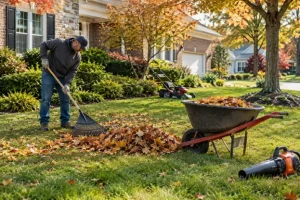
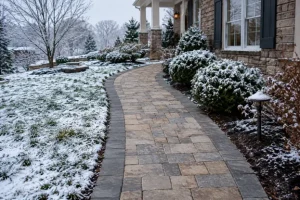
The most important paver repair issues to address before winter include uneven surfaces, recurring puddles, missing joint material, loose edges, and damaged or missing paving units. Addressing these problems early can improve walking conditions, simplify snow removal, and prevent minor defects from being overlooked beneath leaves or snow.
A successful walkway repair starts by identifying why the surface moved or deteriorated. Adding sand, replacing one paver, or applying sealer will not necessarily correct a drainage or foundation problem.
Whether you are maintaining an entrance path, restoring patio access, or improving a walkway for backyard use, this guide explains what to inspect, which repairs deserve priority, and how to prepare your paving for colder weather.
Why Paver Repair Matters Before Winter
Interlocking concrete pavement works as a system. A successful paver repair plan must account for the paving units, joints, edge restraints, bedding, base, and underlying soil, which all influence performance.
The Concrete Masonry & Hardscapes Association (or CMHA) recommends preventive maintenance in spring and fall. Its guidance includes debris removal, joint-sand checks, and inspections for settlement, damaged units, and other signs of distress.
Winter preparation is especially important where raised edges could catch snow-removal equipment or low areas collect water that may freeze.
Not every flaw requires immediate reconstruction. Minor discoloration differs from an unstable walking surface, and a hairline crack differs from a broken unit that moves underfoot.
The goal is to distinguish cosmetic concerns from problems affecting stability, drainage, or everyday access.
1. Start With an Inspection After Rain
A dry-weather inspection can reveal cracks and loose edges, but rainfall helps expose drainage problems.
Walk the route during or shortly after rain when conditions are safe. Look for puddles, water crossing the path, sediment washing into joints, and runoff from nearby roofs or planting beds.
Photograph affected areas and note whether the problem disappears quickly or persists.
CMHA recommends inspecting interlocking concrete pavement during or immediately after rainfall because water makes settlement, ponding, and runoff from adjacent areas easier to identify.
Also inspect the route after dark. Shadows can make height differences appear larger or smaller than they are, so questionable areas may need measurement rather than visual judgment alone.
Use these observations to create a paver repair list before requesting estimates.
2. Reset Uneven Walkway Pavers
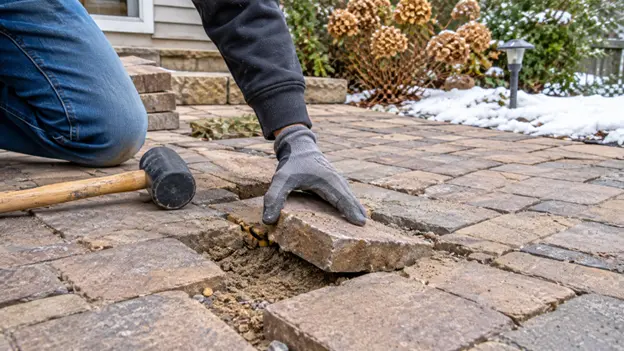
Raised or tilted walkway pavers deserve attention before winter conceals them.
A small height difference can interrupt walking and interfere with shoveling. CMHA recommends repairing lifted units that create more than one-eighth inch of lippage before snow-removal operations begin. This is maintenance guidance, not a universal legal threshold.
The correct repair depends on the cause. Some isolated problems can be resolved by resetting units. Others require work beneath the surface.
Ask whether the movement comes from the bedding layer, supporting base, underlying soil, or another nearby feature.
Do not accept a cosmetic adjustment without understanding why the paver moved. A durable repair should restore stable support and preserve the intended surface drainage.
Restrict access where an obvious hazard remains.
3. Repair Sunken Sections and Depressions
Low areas often reveal problems below the visible paving.
CMHA identifies several possible causes of depressions, including inadequate compaction, saturated supporting layers, washed-out bedding, and excessive bedding-sand thickness.
A paver repair may involve lifting the affected units, correcting the relevant layers, and reinstalling the paving. It does not automatically require replacing the entire walkway.
Avoid simply adding a thick layer of bedding material to conceal deeper settlement. The repair should address the layer that failed.
Ask the contractor to evaluate the surrounding surface as well. Raising one area can redirect water or create an awkward transition nearby.
After completion, inspect the repaired section underfoot and after rainfall. Stable paving and appropriate drainage should be considered together.
4. Correct Recurring Puddles
A puddle is not just an appearance issue when the route is used during freezing weather.
CMHA notes that depressions filled with water can create slippery ice patches in winter. Its repair guidance emphasizes identifying the source of settlement and restoring the affected pavement layers.
However, not every puddle begins beneath the paving. Concentrated roof runoff, blocked outlets, and surrounding grades may also contribute.
A contractor should explain:
- Where the water originates.
- Why it remains on the surface.
- What repair will change.
- Where redirected water will go.
- How the system will be maintained.
Do not assume a new drain is always necessary. Likewise, do not treat repeated deicer application as a substitute for correcting a recurring water problem.
5. Restore Missing Joint Material
Joint material is part of the pavement system, not merely a finishing detail.
CMHA explains that joint sand contributes to interlock and pavement stiffness. Loss can result from pressure washing, concentrated runoff, wind, or saturated bedding material moving under traffic.
Inspect for joints that have become noticeably recessed or empty.
For conventional sand-jointed concrete paving, CMHA recommends promptly replenishing joint sand when it has dropped more than half an inch below the appropriate reference level. The specified material and procedure must suit the installation.
Do not assume every joint needs the same product.
First identify whether the system uses conventional sand, stabilized joint material, or permeable joint aggregate. Then address the reason material was lost before replenishing it.
6. Avoid a Superficial Polymeric-Sand Patch
Polymeric sand can be appropriate in specified installations, but it is not a universal solution for open or failing joints.
CMHA’s conventional pavement maintenance guide specifically advises against using polymeric sand merely to top up existing joints.
If a contractor recommends replacing stabilized joint material, ask how the existing joints will be prepared and whether the proposed method follows the product manufacturer’s instructions.
Weather matters too. Products can have requirements for temperature, surface dryness, activation, and protection from rain.
Do not rush an application into unsuitable conditions simply to finish before winter.
Most importantly, joint products will not correct spreading edges, a failing base, or ongoing washout. Those causes need their own repairs.
7. Secure Loose Edges and Restraints
A paver surface relies on support at its perimeter.
Loose or missing edge restraints can allow units to spread, rotate, and lose joint material. CMHA identifies widening joints and movement near the pavement edge as signs of restraint failure.
Inspect the outer rows of the walkway, especially beside planting beds and transitions to other surfaces.
Look for tilted units, gaps opening toward the perimeter, exposed restraint, or localized settlement.
A proper repair may require rebuilding the edge and resetting adjacent paving—not simply pushing the outer row inward.
Keep decorative edging separate from structural assumptions. A visible garden border is not automatically an effective paver restraint.
Ask the installer to explain how the repaired perimeter will support the pavement and remain serviceable.
8. Replace Broken or Missing Units
Missing pavers leave the surrounding system vulnerable and create an obvious interruption in the walking surface.
CMHA recommends replacing missing units promptly. For damaged pavers, it advises assessing chips, cracks, and spalling and replacing units where necessary, followed by appropriate compaction and joint restoration.
A narrow crack with little or no opening may not affect performance in the same way as a loose, broken piece.
Use compatible replacement units. Thickness, dimensions, intended application, and surface characteristics matter—not just color.
Keep spare pavers when possible. Weathering can make an exact visual match difficult later.
If the same location repeatedly breaks, investigate support or loading rather than replacing units indefinitely without addressing the cause.
9. Investigate Widening Joints and Shifting Patterns
Uneven joint widths can indicate more than missing sand.
CMHA lists poor construction, inadequate restraint, settlement, heaving, and lateral movement among the possible causes of excessive joint width. Its recommended approach is to identify the cause, remove affected paving, correct the problem, and reinstall the units appropriately.
Inspect whether a once-straight pattern now appears distorted.
For a walkway, focus on spreading edges, unstable support, and transitions. For vehicle areas, turning and braking loads may also affect movement.
Do not force individual units back into alignment without assessing the surrounding area.
The finished paver repair should restore a coherent pattern and stable joints, not merely disguise one visible gap.
10. Evaluate Recurring Heave Carefully
A raised section that repeatedly returns after repair may need more than another surface reset.
CMHA identifies frost movement and unstable underlying soil as possible causes of heave. Its guidance calls for correcting frost-related supporting materials and seeking geotechnical advice where the cause is not frost-related.
If nearby roots appear involved, consult an appropriate tree professional before cutting them. Do not assume root removal is harmless to the tree.
Document when movement occurs and whether it changes seasonally. That history can help the contractor investigate.
Avoid promising that any single repair will eliminate all future movement. The scope should reflect site conditions and the diagnosed cause.
Temporary stabilization and permanent reconstruction should be clearly distinguished in the estimate.
Conventional vs. Permeable Pavers: Know the Difference
The maintenance method must match the paving system.
Conventional interlocking concrete pavement and permeable interlocking concrete pavement use different joint and drainage arrangements. CMHA’s conventional maintenance guide explicitly excludes permeable systems, directing readers to separate guidance.
Maintenance issue | Conventional paving | Permeable paving |
Joint restoration | Use specified sand or compatible system | Use specified joint aggregate |
Sediment accumulation | Remove without unnecessarily disturbing joints | Preserve infiltration through appropriate cleaning |
Winter traction material | Follow paving guidance | Avoid ordinary sand that can impair infiltration |
Persistent ponding | Assess grades and supporting layers | Assess infiltration and the complete system |
Repairs | Match the existing construction | Preserve permeable-system function |
CMHA advises against traction sand on permeable concrete paving and identifies suitable joint aggregate as a better alternative where traction material is needed.
Prioritize a Walkway for Backyard Access
A walkway for backyard use may connect the house to a shed, grill, gate, or patio. Decide how important that route is during winter.
If it remains essential, inspect it with the same care as the front entrance.
Check gate approaches, narrow passages, transitions to steps, and locations where garden material washes onto the paving.
If the route is seasonal, decide whether it will remain open or be taken out of use. Make that choice clear rather than leaving an ambiguous path through an unmaintained area.
For future improvements, choose stable circulation and practical maintenance access over decorative complexity.
A successful repair should support the way the path is actually used.
Cleaning and Sealing: Repairs Come First
Cleaning can reveal problems, but aggressive methods can also disturb joints.
CMHA warns that pressure washing and excessive cleaning may remove joint sand. It recommends appropriate cleaners for specific stains and cautions that improper cleaning can damage or discolor pavers.
Do not begin with the strongest chemical or highest pressure available.
Sealing is a separate decision. It may assist with stain resistance in suitable applications, but it does not stabilize a failing base or correct ponding.
If sealing is proposed, ask about compatibility, appearance, traction, preparation, curing conditions, and future maintenance.
Complete structural and drainage repairs first. A surface treatment should not be used to conceal unresolved problems.
Plan Snow Removal Before the First Storm
Repairing raised edges helps reduce the chance of snow-removal equipment catching them.
CMHA recommends shoveling or plowing diagonally across paver joints where practical. It also advises considering plastic shovels or synthetic blade edges where surface appearance is important.
Inspect equipment settings and wear components before use.
Identify where snow can be stored without blocking the path or creating runoff that repeatedly crosses it.
Tell maintenance providers about repaired areas, vulnerable borders, and nearby fixtures.
Remove loose debris before snow arrives. CMHA notes that debris and accumulated traction material can contribute to scratching and abrasion.
Good winter care protects the repair rather than immediately subjecting it to avoidable damage.
Use Deicers Sparingly and Appropriately
No deicer should be treated as universally harmless.
For concrete pavers, CMHA recommends using only the amount needed, following product directions, and removing loosened ice and excess salts promptly. It advises against using deicers as a replacement for snow removal.
CMHA identifies sodium chloride as less damaging to concrete than certain alternatives and advises against magnesium chloride and calcium magnesium acetate for these concrete systems.
Check the paving manufacturer’s instructions before selecting a product. Do not generalize concrete-paver guidance to every natural stone or clay installation.
Protect nearby plants and metals, and consider runoff.
Where the same spot repeatedly ices, revisit drainage rather than relying on increasingly heavy chemical application.
DIY Paver Repair or Professional Help?
Some maintenance tasks are straightforward, but repair difficulty depends on the cause.
Homeowners may be comfortable sweeping debris, documenting defects, and performing approved routine joint maintenance.
Professional help is especially useful for recurring settlement, substantial height changes, edge reconstruction, drainage work, or uncertain underlying conditions.
If excavation is involved, arrange applicable utility locating before work begins. CMHA’s restoration guidance calls for establishing utility locations before excavation.
Ask for a written scope explaining:
- The diagnosed problem
- The area and depth of work
- Materials to be reused or replaced
- Drainage corrections
- Joint and edge treatment
- Cleanup and restoration
- Weather-related limitations
- Warranty terms
A clear explanation is more valuable than a promise to “make it level.”
Budget for the Cause, Not Just the Symptom
Compare paver repair estimates using equivalent scopes.
One proposal may cover lifting and resetting units, while another includes base repair, edge replacement, and drainage correction.
Prioritize:
- Unsafe or missing paving
- Recurring water accumulation
- Failing edges and supporting layers
- Joint restoration
- Cosmetic cleaning or optional treatments
Ask whether a localized repair is practical. CMHA explains that segmental paving can often be opened and reinstated without rebuilding the entire installation.
However, repeated patching may be poor value when the broader construction is unsuitable.
Choose the scope that addresses the problem responsibly.
Your Pre-Winter Paver Checklist
Before winter arrives:
- Inspect after rainfall
- Photograph settlement and ponding
- Check walkway pavers for movement
- Review joints and perimeter restraint
- Replace missing or unstable units
- Confirm the paving system type
- Resolve recurring drainage problems
- Select compatible winter-maintenance products
- Prepare snow-removal tools
- Keep repair and product records
Reinspect after the first major storms and during spring cleanup. Maintenance is easier when changes are identified early.
Schedule Your Paver Repair Before Winter
Start with stability and water management. A well-executed walkway repair should correct the cause of movement, restore appropriate joints and edges, and leave the route practical to maintain.
Ready to get your outdoor paving ready for winter? Hawkins Landscaping Inc. can help improve the appearance, safety, and functionality of your property’s walkways and hardscape areas. From uneven pavers to drainage concerns, identifying areas that need attention can help prevent minor issues from becoming bigger problems.
Whether you are restoring entrance walkway pavers or improving a walkway for backyard access, the right paver repair plan makes a difference. Address loose or uneven pavers, water drainage, and surface stability first, then consider cosmetic upgrades that complement your home’s landscape. Timely maintenance can help create a more dependable walkway throughout the colder months.
With over 50 years of experience serving Frederick County and surrounding areas, Hawkins Landscaping Inc. can help you plan practical hardscaping improvements that keep your outdoor spaces attractive and functional.
Ready to improve your walkway or other paved surfaces? Call (301) 898-3615 or visit hawkinslandscaping.com to schedule your consultation. Ask about our flexible financing options for your outdoor project.