Preparing your walkways for winter starts with three priorities: a stable surface, dependable drainage, and clear visibility. In Frederick, Maryland, a thoughtful walkway design matters whether you are improving a garden path, repairing patio access, or updating the walkway to front door.
A beautiful path should remain practical when leaves fall, rain collects, and snow arrives. That means correcting uneven paving, clearing drainage routes, inspecting edges, choosing appropriate outdoor lighting, and planning snow removal before the first storm.
This guide combines winter maintenance with long-term walkway design. You will find practical walkway ideas, material comparisons, lighting guidance, local snow-removal information, and advice on choosing a contractor.
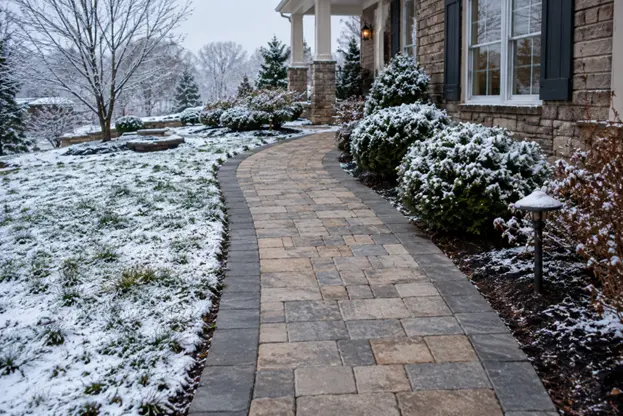
Why Walkway Design Matters for Winter Preparation
Winter maintenance becomes easier when the walkway is designed around how people use it. A direct, stable route from the driveway to the entrance is generally more practical than a decorative path that forces visitors through narrow turns or across widely spaced stones.
Drainage, base construction, edging, and access all affect performance. Paving materials alone cannot compensate for water collecting beneath the surface or a path that is difficult to clear.
The Concrete Masonry & Hardscapes Association recommends a pre-winter inspection that checks joint material, loose pavers, secure edge restraints, and signs of shifting or settlement.
Treat that inspection as a walkway design review as well as a maintenance task. If the same section becomes muddy, dark, or uneven every year, consider whether the layout or construction needs improvement rather than another temporary repair.
1. Inspect Your Walkways After Rain
A dry-weather inspection can reveal cracks and loose paving, but rainfall shows how the walkway manages water. Walk the route during or shortly after rain when it is safe to do so.
Look for puddles, water flowing across steps, downspouts discharging onto paving, eroded edges, and mulch washing out of nearby beds. Photograph recurring problems so they remain easy to identify when a contractor visits.
Pay attention to transitions. The junction between a driveway and walkway, the bottom of porch steps, and the entrance to a patio may collect water even when most of the path drains well.
Do not assume every puddle needs a drain. A sunken section, obstructed outlet, or poorly directed downspout may be the cause. The repair should address where the water comes from and where it can safely go.
2. Prioritize the Main Entrance Route
The most important winter route is usually the path connecting parking areas, the public sidewalk, and the front entrance. It should be easy to identify, comfortable to use, and practical to maintain.
Review the walkway to front door with everyday tasks in mind. Can someone carry groceries without brushing through shrubs? Is there room to pause near the entrance? Do doors open without conflicting with furniture, planters, or railings?
If the route is too narrow or awkward, a change to the walkway design may be more useful than repeated seasonal cleanup. A wider landing or a better connection to the driveway can improve the experience without rebuilding the entire yard.
Keep frequently used winter routes visually simple. Decorative stepping stones may suit a garden, but continuous paving is often more practical where reliable footing and snow clearing are priorities.
3. Reset Loose or Sunken Pavers
Rocking pavers and raised edges deserve attention before snow conceals them. They can interrupt walking, catch shovel blades, and indicate a problem in the layers beneath the surface.
A localized repair may involve lifting affected units, correcting the bedding or base, compacting where appropriate, and reinstalling the pavers at the intended elevation. Broader settlement may require a more extensive rebuild.
Frederick-area restoration contractors describe repairs that sometimes include removing paving, rebuilding and compacting the base, adding drainage where necessary, and reinstalling the original units.
Ask why the pavers moved. If concentrated runoff continues washing material away, resetting the surface alone may not last.
After repairs, check that individual units do not rock and that the finished surface maintains its intended drainage rather than creating a new low spot.
4. Repair Cracked Concrete and Damaged Stone
Concrete cracks and broken stone require different responses depending on their cause and severity. A narrow, stable crack is not the same as a slab with significant vertical displacement.
Clean the surface and assess the damage before selecting a repair product. Note whether cracks are expanding, whether sections move underfoot, and whether nearby drainage or roots may be contributing.
For small repairs, use products intended for the material and exposure, following temperature, moisture, and curing instructions. Do not apply a filler simply to conceal a changing or uneven surface.
A badly displaced slab, loose stone tread, or repeated crack may need professional evaluation. Surface repairs will not necessarily correct underlying movement.
If work cannot be completed safely before freezing conditions, ask about temporary access arrangements. Keeping people away from a hazard is more important than rushing an unsuitable repair.
5. Restore Edges and Joint Material
Walkway edges help maintain the shape of a paver surface and contain loose materials beside it. Inspect restraints, brick borders, metal edging, and stone margins for movement.
Look for pavers spreading outward, missing joint material, exposed restraint, and soil or mulch covering the perimeter. Correcting the edge can be essential to keeping the repaired surface stable.
For conventional paver systems, joint material should match the installation and manufacturer’s requirements. Do not assume every open joint should receive polymeric sand.
Permeable pavers are different. CMHA advises keeping their joints clear for infiltration and specifically warns against using polymeric sand or sealers that would block water movement.
Identify the paving system before approving maintenance. A product suitable for one walkway can interfere with the function of another.
6. Correct Water Flow Before Adding Finishes
Drainage is one of the most valuable improvements to consider in walkway design before winter. A path that collects runoff needs a water-management plan, not just a new decorative border.. A path that collects runoff needs a water-management plan, not just a new decorative border.
Possible work may include resetting a low section, adjusting adjacent grades, redirecting downspout discharge, or installing a suitable channel or drainage feature. The right approach depends on the property.
Ask the contractor to explain the outlet and maintenance requirements. Collected water must have an appropriate destination; moving it toward a neighboring property or another vulnerable area is not a complete solution.
Avoid raising soil against siding or creating a border that traps runoff beside the house. Consider both the walkway and surrounding landscape.
For complex conditions near foundations, slopes, or retaining walls, seek qualified drainage and construction guidance before excavation.
Choose Materials for Winter Use
The best walkway material depends on the route’s function, maintenance needs, and site conditions. Appearance matters, but traction, repairability, drainage, and snow-removal access deserve equal attention.
Material | Useful applications | Winter-planning consideration |
Concrete pavers | Main routes, patios, backyard connections | Inspect joints, restraints, and settlement |
Exterior paving brick | Traditional entrances and garden paths | Confirm product suitability and stable support |
Natural stone | Formal or informal garden routes | Choose appropriate texture and consistent footing |
Poured concrete | Continuous entrance paths | Monitor cracks, displacement, and drainage |
Permeable pavers | Suitable stormwater-conscious installations | Preserve open joints and follow system-specific care |
Gravel | Secondary garden and service paths | Plan containment and realistic snow clearing |
Stepping stones | Lightly used garden routes | Keep stones stable and do not hide uneven gaps |
For an essential entrance route, prioritize predictable footing over highly irregular surfaces when considering walkway design. For a secondary garden path, a more informal material may be appropriate.
Request product-specific maintenance instructions. “Natural stone” and “concrete paver” describe broad categories, not identical performance across every product.
Walkway Lights Outdoor: Improve Winter Visibility
Homeowners searching for “walkway lights outdoor” should begin with placement and visibility rather than brightness alone. Lighting needs to reveal the walking surface, steps, turns, and entrance without shining directly into people’s eyes.
Inspect your walkway after dark. Check the route from the driveway, both directions on stairs, and the final approach to the door. A bright porch fixture may leave the path itself poorly defined.
Low path fixtures, shielded step lights, wall lights, and appropriate post lights can serve different purposes. Test proposed locations before permanent installation where practical.
Keep fixtures out of the clear walking area and anticipated shovel route. They should also remain accessible for cleaning and maintenance.
For permanent wiring, new outlets, or integrated stair lighting, use qualified professionals and equipment rated for its actual outdoor exposure.
Plant Borders That Do Not Obstruct Access
Planting can frame a walkway beautifully, but winter access should guide the walkway design. Plants that spill across paving or conceal steps make maintenance more difficult.
Choose species according to mature size, light, moisture, and the space available. Position larger shrubs and arching grasses far enough back to preserve the walking route.
Keep entrances, turns, and landings especially clear. Seasonal containers should not reduce the usable width or interfere with door movement.
Think about snow storage when planning beds. A narrow strip beside the driveway may receive plowed snow and deicing residue, making it a challenging location for sensitive planting.
A simple border with repeated plants and defined edging often provides a cleaner result than a dense collection of unrelated specimens. Leave sufficient access to inspect lights, drains, and paving edges.
Plan Snow Removal Before the First Storm
Snow-removal planning should be part of walkway design. Identify the routes that must remain open, where snow can be placed, and which tools suit the surface.
Keep shovels and approved treatment products accessible rather than behind a gate or storage area that may become blocked.
For pavers, Unilock recommends plastic shovels or plastic blade covers to reduce scratching and chipping associated with metal blades. Follow the guidance for your particular walkway material and equipment.
Mark vulnerable edges where appropriate, especially along raised borders or curves. Move loose planters and decorations before storms.
Do not pile snow where meltwater will flow back across the route and refreeze. Keep drainage openings clear and consider how roof runoff will affect the entrance during thawing weather.
Understand Frederick’s Sidewalk Responsibilities
Private garden paths and public-facing sidewalks are not the same, but both need a maintenance plan.
Within the City of Frederick, the city’s snow-removal guidance states that property owners are responsible for clearing snow and ice from sidewalks within 12 hours after snowfall ends. The city also directs residents not to push or shovel snow into public streets or sidewalks.
Do not assume that a Frederick mailing address automatically places your property within city jurisdiction. Confirm which municipality, county requirements, or community rules apply.
Frederick County explains that road-plowing responsibilities can belong to the state, county, a municipality, or a private entity such as an HOA. Property owners remain responsible for clearing driveway access.
Arrange help in advance if you travel, have mobility limitations, or cannot reliably clear required routes.
Use Deicers Carefully
There is no single deicer that is automatically best for every paving surface, temperature, planting bed, and drainage situation.
Follow the walkway manufacturer’s guidance and the treatment product’s label. Avoid assuming that a product advertised as “safe” cannot damage plants, metals, or masonry when overapplied.
Frederick County recommends shoveling first, using deicer sparingly, following label instructions, and avoiding application before rain. The county notes that storm drains carry runoff directly to waterways without treatment.
For its concrete pavers, Unilock advises avoiding magnesium-based products and using compatible deicers cautiously. That recommendation should not be generalized to every natural stone or masonry installation.
After snow and ice melt, remove excess material where appropriate. A preventive maintenance plan should reduce reliance on chemicals rather than compensate for unresolved drainage with repeated heavy application.
Maintain Permeable Walkways Differently
Permeable paving can support water management when properly designed and installed, but it requires maintenance that preserves infiltration.
Clear leaves, soil, and organic debris from the surface. Ask the installer how the joints should be maintained and whether specialized cleaning is needed.
CMHA notes that permeable paver maintenance may eventually involve vacuuming and replacing joint aggregate. It also advises against polymeric sand and sealers that block infiltration.
Traction materials need care, too. Do not assume sand recommended for a conventional paver walkway is appropriate for an infiltration system.
If a permeable walkway is holding water, have its condition evaluated rather than treating the surface as a standard patio. The solution may involve joint cleaning, base performance, or other system-specific issues.
Decide Whether Sealing Is Necessary
Sealing is not an automatic pre-winter requirement. Some installations benefit from a suitable treatment; others do not need it or require a different approach.
Ask what the proposed sealer will accomplish, whether it changes appearance or traction, and how it affects maintenance. Confirm compatibility with the exact paving material.
Repairs and drainage correction should come first. A sealer cannot stabilize a failing base or eliminate standing water caused by poor grading.
Weather also matters. Products may require specific surface dryness, temperatures, and curing periods. Do not rush application immediately before unsuitable conditions.
For permeable systems, follow manufacturer guidance carefully. CMHA specifically cautions against sealers that interfere with water infiltration.
Hire the Right Frederick Walkway Contractor
Choose a contractor with experience in the work you actually need. New construction, paver restoration, masonry steps, drainage, and landscape lighting involve different skills.
Ask for examples of similar projects and an explanation of the proposed repair. A useful estimate should identify preparation, materials, drainage, edging, cleanup, and restoration.
Verify applicable credentials and insurance, and clarify responsibility for permits or inspections. Do not assume every private path requires approval—or that no approval is needed.
Ask how weather could affect the schedule and which work might be better deferred. A contractor should be willing to explain limitations rather than promise completion regardless of conditions.
Written aftercare instructions are valuable. Keep product information, photographs, warranty terms, and maintenance guidance together for future reference.
Your Pre-Winter Walkway Checklist
Use this checklist to turn the inspection into a practical plan:
- Repair loose paving, unsafe steps, and unstable railings.
- Identify recurring puddles and correct their cause.
- Restore appropriate joint material and edge restraint.
- Clear leaves from paving, drains, and permeable joints.
- Test path and step lighting after dark.
- Remove decorations that obstruct access.
- Select compatible snow-removal tools and deicers.
- Plan snow storage and confirm local responsibilities.
- Schedule professional repairs before conditions limit the work.
Recheck the route after the first major rainfall and again after winter weather begins. An early adjustment may prevent a recurring problem.
Prepare for Winter With Thoughtful Walkway Design
A winter-ready walkway design combines dependable footing, thoughtful drainage, clear lighting, and a realistic maintenance plan. Start with the route you use most, then address secondary paths and backyard connections.
Ready to improve your outdoor access before winter arrives? Contact Hawkins Landscaping Inc. for professional landscaping and hardscaping services tailored to your property. Our team can help assess your walkways, identify potential issues with settling, water collection, and visibility, and recommend practical solutions for a safer, more functional outdoor space.
Whether you need outdoor walkway lighting, paver restoration, improved drainage, or a more welcoming walkway to your front door, thoughtful planning can make a big difference. From durable paving materials and attractive landscape borders to strategically placed lighting, the right improvements can enhance safety, simplify maintenance, and boost your property’s curb appeal.
With over 50 years of experience serving Frederick County and surrounding areas, Hawkins Landscaping Inc. can help you prepare your walkways for winter while creating an attractive landscape you can enjoy in the seasons ahead.
Ready to upgrade your walkways? Call (301) 898-3615 or visit hawkinslandscaping.com to schedule your consultation. Ask about our flexible financing options for your outdoor project.