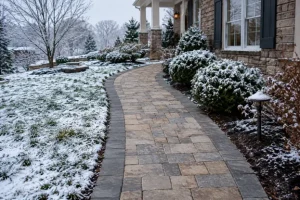
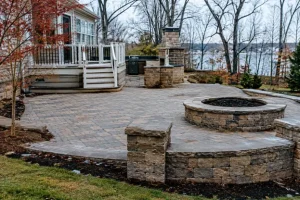
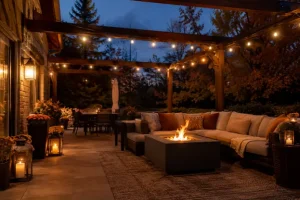
November changes the way you experience your patio. The garden becomes quieter, outdoor gatherings move closer to the house, and an early evening can feel like nighttime before dinner begins. Without patio lighting, even an attractive outdoor area may become a place you see through the window rather than use.
The best patio lights create a comfortable setting while making steps, walking routes, and everyday tasks easier to see. Start with dependable access lighting, add focused illumination where you cook or dine, and finish with a restrained decorative layer.
This guide explores practical patio ideas for darker November nights, including fixture placement, color temperature, electrical safety, seasonal maintenance, and patio installation planning.
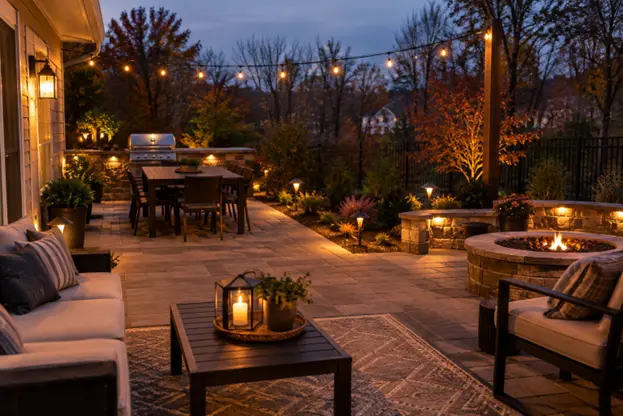
Start With a Patio Lighting Plan, Not a Shopping List
Before buying fixtures, identify how you want to use the patio in November. A space for quick trips to the grill needs a different arrangement from an outdoor dining area or a quiet reading corner.
Sketch the patio and mark doors, steps, furniture, cooking equipment, and nearby paths. Note existing outlets and fixtures without assuming they are suitable for every proposed use.
Then walk through the space after dark. Check where you hesitate, where furniture blocks light, and whether an existing fixture shines directly into your eyes.
DarkSky’s responsible-lighting principles recommend giving every light a clear purpose, directing it only where needed, and keeping brightness no higher than necessary.
Use those principles to decide where patio lighting will serve a clear purpose before choosing decorative styles.
1. Build the Design Around Three Lighting Roles
A useful patio plan separates access, task, and atmosphere lighting.
Access lighting helps people follow the route between the house, seating, steps, and garden. Task lighting supports activities such as cooking, serving food, or reading. Atmospheric lighting gives the space character.
These roles can overlap, but one fixture rarely performs all of them equally well. String lights may create a pleasant canopy while leaving the bottom step difficult to distinguish.
Start with the essential route, then add lighting for activities. Decorative fixtures come last.
This approach follows the broader principle of targeted lighting: illuminating the intended area rather than increasing brightness across the entire property. The U.S. Department of Energy notes that better optical control can reduce the amount of light needed while limiting unwanted spill.
2. Use String Lights to Define an Outdoor Room
String lights can make a patio feel more enclosed and intentional without adding walls.
Choose a layout that suits the space. Parallel strands can emphasize a rectangular dining area, while a simple perimeter arrangement may suit a pergola. A small patio might need only one restrained run.
Measure the route before purchasing, including the connection to power. Follow the manufacturer’s requirements for mounting, support, maximum connected length, and weather exposure.
Avoid hanging lights where they interfere with doors, branches, umbrellas, or normal movement. Do not use electrical cords as improvised structural supports.
For a calmer effect, choose a compatible dimmable system rather than relying on maximum brightness.
String lights should complement functional fixtures. Keep separate illumination for steps and other locations where decorative glow does not clearly reveal the surface.
3. Make Steps and Landings a Priority
November lighting should begin with the places where people change level.
Inspect patio steps from both directions. Look at the top and bottom landings as well as the treads. A fixture that works when descending may create glare when climbing.
Possible options include suitable recessed riser lights, shielded side-mounted fixtures, and appropriately designed lighting beneath a projecting edge.
The objective is to reveal the walking surface without putting a bright source directly in the user’s line of sight.
For an existing stairway, ask an installer about retrofit options before cutting masonry or routing cable.
During a new patio installation, coordinate step lighting with construction. Fixture positions, wiring routes, drainage, and future replacement access are easier to resolve before the finished surfaces are complete.
4. Guide the Route Between the House and Patio
A comfortable seating area is less useful if the approach disappears into darkness.
Follow the route from the door to the patio and any connected garden path. Identify turns, narrow points, and changes in surface.
Use fixtures that direct light toward the route rather than broadcasting it across the yard. Keep them outside the usable walking space and away from likely snow-clearing activity.
Do not select spacing from a universal rule alone. Fixture output, beam distribution, mounting height, and path width all affect placement.
Test proposed locations after dark when practical.
DarkSky recommends containing light within its intended area and turning it off or dimming it when unnecessary. A clearly defined route does not require every nearby planting bed to be illuminated.
5. Bring Light to the Table
Table-level lighting offers flexibility without changing the entire patio.
A rechargeable lamp can support conversation, serving, or a board game. Choose a shaded design that directs light toward the tabletop rather than exposing a bright source between guests.
For dining, keep the arrangement low enough to preserve sightlines. Two smaller lamps may suit a long table better than one oversized centerpiece.
Confirm the product’s outdoor rating, temperature limits, charging requirements, and storage instructions. Rechargeable does not automatically mean suitable for rain or freezing conditions.
Portable lamps are also useful for testing your patio lighting layout. Move them between seating positions before deciding whether permanent fixtures are necessary.
Store them as directed when the patio is not in use.
6. Add Lanterns Without Cluttering the Patio
Lanterns offer a simple transition from autumn decorating to winter entertaining.
Place them on stable side tables, broad ledges, or other suitable surfaces outside the walking route. Avoid arrangements that require guests to step around objects.
Battery-operated lanterns can provide a candlelike effect without an open flame beside cushions and seasonal decorations.
Repeat one finish or shape to keep the display coordinated. A small group beside a seating area often looks more intentional than scattered pieces across the entire patio.
Lanterns remain decorative supplements, not substitutes for dependable stair lighting.
Before purchasing, consider where they will be stored and how often batteries or rechargeable units need attention. Attractive patio accessories should not create an unnecessarily complicated maintenance routine.
7. Illuminate the Grill and Preparation Area Separately
Cooking needs more focused visibility than relaxed conversation.
Check whether you can clearly see the grill controls, cooking surface, preparation counter, and serving area. Test the arrangement with the grill lid both open and closed.
Position lighting so your body does not cast a strong shadow over the task.
Choose equipment suitable for the environment, and keep fixtures and wiring away from heat and moving appliance parts according to applicable instructions.
A dedicated task light allows the cooking area to remain useful without making the lounge area overly bright.
For an outdoor kitchen, coordinate patio lighting with appliance placement, power, service access, and required clearances. These details belong in the installation plan rather than becoming improvised additions after construction.
8. Use Wall Lights With Controlled Output
A wall-mounted fixture can provide dependable illumination near the patio door, but its position and light distribution matter.
Look for a design that directs light where needed rather than exposing a bright bulb at eye level.
Assess the effect from inside the house as well as outside. A fixture that reflects strongly in glass may interfere with the view of the patio.
If one powerful light creates uncomfortable contrast, consider whether several restrained sources would better serve the layout.
Do not assume replacing a bulb with a brighter version solves every visibility problem.
The Department of Energy emphasizes optical control and targeted output as ways to reduce off-target light while maintaining useful illumination.
9. Reveal Selected Garden Features
A completely dark garden can make the patio feel disconnected from its surroundings. Selective accent lighting can provide a visual connection without illuminating every plant.
Choose one or two features visible from the seating area, such as a textured wall, planter, or architectural detail.
Aim carefully and review the effect from the chairs. The fixture itself should not become the dominant feature.
Whenever practical, favor shielded, downward-directed light rather than beams extending into the sky.
Leave darkness between accents. Contrast helps individual features remain distinct and prevents the patio from feeling visually crowded.
Responsible-lighting guidance recommends light only where it serves a purpose, with the lowest effective output and controls that limit unnecessary operation.
Choose Color Temperature and Brightness Separately
Color temperature describes the appearance of light; brightness describes how much light a fixture delivers. A warm-colored bulb can still be uncomfortably bright.
For a coordinated November patio, compare the appearance of all visible fixtures before purchasing. Mixing golden decorative lights with strongly cool-white path lights can make the design feel disconnected.
DarkSky highlights shielded, dimmable 2700K lighting as an example of warm illumination that can provide useful visibility without unnecessary glare or spill.
Use that as a reference point, not a substitute for evaluating the product.
Patio zone | Lighting priority |
Steps and landings | Recognizable edges and transitions |
Walking route | Clear direction without glare |
Dining table | Useful light on food and faces |
Grill station | Focused working visibility |
Lounge seating | Comfortable, restrained illumination |
Garden accents | Selective visual interest |
10. Use Patio Lighting Controls That Match Real Activity
A patio should not remain fully illuminated simply because darkness arrives early.
Separate controls make the space more adaptable. You might use task lighting while cooking, reduce dining illumination after the meal, and switch decorative accents off when everyone goes inside.
The Department of Energy identifies photosensors, motion sensors, and timers as useful outdoor-lighting controls. Photosensors respond to ambient light, while timers can limit decorative lighting to selected evening hours.
Motion sensors may suit occasional-use access areas, but abrupt activation can be distracting beside a lounge.
Check compatibility among LEDs, dimmers, transformers, and smart controls. If internet-connected features are involved, consider how the lights operate when the network is unavailable.
Plan Electrical Safety Before Decorating
Outdoor lighting must suit outdoor conditions.
The Electrical Safety Foundation International recommends outdoor-marked cords and decorations, matching electrical loads to cord ratings, using GFCI-protected circuits, and inspecting equipment for damage. It also advises keeping cords and light strings clear of standing water and snow.
Do not run cords through the walking route or conceal damaged connections beneath decorations.
For permanent lighting, new receptacles, or uncertain existing wiring, consult a qualified electrician.
Ask about the actual exposure at each location. A roofed patio may still receive wind-driven rain.
Avoid treating a temporary extension-cord arrangement as the long-term plan for a permanent outdoor living area.
Coordinate Lighting With Patio Installation
The easiest time to plan integrated lighting is before the patio is finished.
During patio installation, discuss:
- Fixture locations and mounting details.
- Cable routes and appropriate conduit.
- Electrical supply and controls.
- Step and wall-light placement.
- Drainage around equipment.
- Access for maintenance and replacement.
- Future lighting needs.
Ask for a simple drawing showing the intended system.
Do not let concealment take priority over serviceability. A beautifully hidden component is not an advantage if replacing it requires unnecessary demolition.
Coordinate the hardscape contractor, electrician, and lighting installer so responsibilities are clear. This reduces the chance that one trade finishes work before another has the access it needs.
Adapt the Plan to Your Patio Size
Small patios benefit from restraint. A useful starting arrangement might include the entrance fixture, appropriate step lighting, and one portable table lamp.
Medium patios often need separate attention for dining, lounging, and circulation.
Large patios benefit from defined zones rather than uniform brightness across the entire area.
For a covered patio, verify fixture suitability and mounting requirements. For an open patio, consider exposure and the availability of safe support points.
A fire feature may create atmosphere, but it should not replace lighting for access routes. Keep all fixtures, wiring, and accessories outside required heat clearances.
The best patio lighting ideas respond to actual use. A compact, comfortable setup can be more successful than an elaborate system with unnecessary lights.
Maintain the System Through November
Short maintenance checks help preserve the intended effect.
Remove leaves and debris from fixtures. Check whether seasonal plant growth or moved furniture blocks light.
Inspect cords, sockets, mounting points, and accessible connections. ESFI recommends checking outdoor lighting equipment for damage before use.
Adjust timers as your schedule changes. Review the patio after dark rather than relying only on a daytime inspection.
Follow manufacturer instructions for storing portable lamps and temperature-sensitive accessories.
If a fixture repeatedly fails or a circuit trips, have the cause evaluated rather than repeatedly resetting or replacing parts without diagnosis.
Lighting can reveal the route, but it cannot correct slippery paving, unstable steps, or poor drainage.
Budget for Purposeful Improvements
Start with the problems that affect everyday use.
A sensible sequence is:
- Correct unsafe or unsuitable electrical arrangements.
- Improve steps and access lighting.
- Add focused cooking or dining illumination.
- Introduce decorative lighting.
- Add automation where it provides a clear benefit.
Compare proposals using the same scope. Fixture quality, installation, controls, wiring, and restoration may be priced separately.
Ask for a phased plan if the budget is limited.
Avoid buying several inexpensive decorative products before resolving the one dark stairway or inconvenient power connection that prevents comfortable use of the patio.
Common Patio Lighting Mistakes
The most frequent mistakes include relying on one glaring fixture, placing exposed bulbs at eye level, crowding the patio with lanterns, and lighting features that do not serve a clear purpose.
Other problems arise from incompatible dimmers, poorly planned cable routes, and leaving decorative lights on throughout the night.
The shared solution is a purpose-first design: useful, targeted, controlled lighting with restrained output and warmer colors where possible.
Before finalizing the layout, sit in every main seating position and walk each route. Make adjustments based on the experience of using the space, not only its appearance in photographs.
Make Darker November Nights More Comfortable With Patio Lighting
Darker evenings do not have to end your outdoor season. A clear route, comfortable seating light, and focused illumination for cooking or dining can make the patio more inviting without overwhelming it.
Ready to make your patio more inviting after sunset? Contact Hawkins Landscaping Inc. for professional landscaping and outdoor living solutions that can enhance the beauty, comfort, and functionality of your space. Our team can help you explore practical patio ideas and coordinate landscape features with lighting that complements your outdoor design.
Whether you are upgrading existing patio lights or planning a complete patio installation, thoughtful planning can make a difference. Consider visibility along walkways, glare reduction, convenient lighting controls, and easy maintenance when planning patio lighting. Hawkins Landscaping Inc. can help you plan an attractive outdoor setting, while qualified lighting professionals handle the appropriate electrical installation and safety requirements.
With over 50 years of experience serving Frederick County and surrounding areas, Hawkins Landscaping Inc. is ready to help bring your outdoor improvement ideas to life.
Ready to enhance your patio? Call (301) 898-3615 or visit hawkinslandscaping.com to schedule your consultation. Ask about our flexible financing options for your outdoor project.