Sloped yards can be beautiful, but they often present practical challenges. Rainwater moves quickly downhill, soil can wash away, grass may be difficult to mow, and outdoor areas can feel hard to use. These challenges make landscape solutions especially important when planning improvements. Early fall is an excellent time to address these issues because cooler weather makes outdoor projects more manageable and can give newly planted trees, shrubs, grasses, and ground covers time to establish before the next growing season.
The best landscape solutions for a sloped yard combine drainage, erosion control, planting, and hardscape. A successful plan does not simply cover a hillside with mulch or rocks. It slows water, holds soil in place, creates usable zones, and improves the appearance of the entire property.
This guide shares 15 practical landscape yard ideas for slopes, from simple planting upgrades to terracing, retaining walls, paths, and drainage improvements. It also explains when a project can be DIY-friendly and when a professional landscape design plan is the safer choice.
Safety note: A steep slope, retaining wall, persistent erosion problem, or water moving toward a house may require professional assessment. Do not begin major grading, wall construction, or drainage changes without understanding utility locations, property boundaries, local permits, and where runoff will be directed.
Why Early Fall Is a Good Time for Landscape Solutions for Sloped Yards
Early fall often brings cooler temperatures, less intense sun, and more comfortable working conditions. It is also a useful season for observing how water moves through a yard after rain, helping you plan effective landscape solutions for the slope.
Before starting a project, walk the slope during or after a storm and look for:
- Rills or channels carved into soil
- Exposed roots
- Puddles at the bottom of the slope
- Mulch washed into lawns or walkways
- Soil buildup near patios or foundations
- Downspouts discharging onto the hill
- Bare patches where grass will not hold
- Areas where the slope is too steep to mow safely
- Cracked walls, leaning borders, or shifting pavers
Early fall planting can be especially helpful because roots have time to develop in cooler conditions. Deep-rooted native grasses, sedges, trees, and shrubs can help hold soil in place and reduce erosion over time.
1. Evaluate the Slope Before Designing
The first step in any sloped-yard project is understanding what kind of slope you have. A gentle incline may only need plants and mulch, while a steep or unstable hillside may need retaining walls, terraces, drainage work, or engineering.
Consider:
- How steep the slope is.
- Its total height and length.
- Whether the soil is sandy, clay-heavy, rocky, or compacted.
- How quickly rainwater moves downhill.
- Whether runoff reaches the foundation.
- Whether the slope receives full sun, shade, or mixed light.
- Whether it contains mature trees or major roots.
- Whether the area needs to be mowed.
- Whether you need a path, seating space, or planting bed.
A slight slope can often be stabilized with plants, rock, mulch, and basic erosion control. Medium slopes may benefit from landscape fabric and more deliberate planting, while steep hillsides often need structural solutions such as retaining walls or terracing. Choosing the right landscape solutions starts with understanding the slope and its specific challenges.
2. Install Deep-Rooted Native Plants
Plants are one of the most natural and effective tools for slope stabilization. Their roots bind soil, slow surface runoff, and reduce the force of rain hitting bare ground.
Potential plant categories include:
- Native grasses
- Sedges
- Ground covers
- Shrubs
- Small trees
- Perennial wildflowers
- Ferns for shaded slopes
- Drought-tolerant plants for sunny slopes
Deep-rooted plants can help stabilize soil, while ground covers help protect bare areas from erosion. Examples may include yarrow, creeping mahonia, hostas, creeping phlox, sedges, and ferns, depending on region and site conditions.
3. Create a Layered Slope Planting Plan
A slope is more stable when it has layered planting rather than a thin cover of grass or mulch. Mix plants of different heights, root structures, and growth habits.
A layered slope planting may include:
- Ground covers at the front and between larger plants.
- Clumping grasses to stabilize soil.
- Perennials for seasonal flowers.
- Shrubs for deeper roots and structure.
- Small trees at appropriate locations.
- Mulch between new plants while they establish.
Plant in staggered drifts rather than straight rows. This helps distribute roots more evenly and creates a natural appearance.
4. Use Erosion-Control Blankets
Erosion-control blankets are useful on freshly seeded or newly planted slopes. They are typically made from straw, coconut fiber, jute, or biodegradable materials that protect soil from wind and water while plants establish.
Use blankets on:
- Newly seeded grass areas
- Bare slopes
- Freshly graded soil
- Areas below downspouts
- New native-plant installations
- Slopes with recent erosion channels
- Temporary construction-disturbed areas
A straw blanket can help protect grass seed and soil as vegetation establishes on a slope. Avoid using lightweight plastic sheeting as a long-term erosion solution.
5. Add Ground Covers for Gentle Slopes
Ground covers are one of the simplest landscape yard ideas for mild slopes. They reduce exposed soil, limit weeds, and create a living carpet that can be easier to maintain than lawn.
Good slope ground-cover options depend on the region but may include:
- Creeping phlox
- Ajuga
- Sedum
- Creeping juniper
- Pachysandra
- Native strawberries
- Bearberry
- Creeping thyme
- Vinca alternatives where non-invasive
- Native sedges
Use ground covers only where foot traffic is light. If people regularly cross the slope, install stepping stones, stairs, or a defined path rather than expecting plants to withstand repeated trampling.
6. Terrace a Steep Backyard
Terracing divides a long slope into smaller, more manageable levels. Each level slows water, creates flat planting or seating space, and reduces the amount of soil moving downhill.
Terraces can be built using:
- Natural stone
- Segmental retaining-wall block
- Timber
- Brick
- Concrete
- Large boulders
- Gabion baskets in suitable designs
A series of smaller terraces is often more stable and visually appealing than one tall wall. Terracing creates usable flat areas while helping soil stay in place.
7. Build a Retaining Wall
A retaining wall holds soil in place and can transform a difficult slope into usable backyard space. It is one of the most effective landscape solutions for steep grades, but it must be designed correctly.
A proper retaining wall typically needs:
- Excavation
- A compacted gravel base
- Level first course
- Drainage aggregate behind the wall
- Drainpipe or weep drainage where required
- Filter fabric
- Proper backfill
- Correct wall-batter or setback
- Capstones or a finished top edge
Inadequate drainage is a leading cause of wall failure. Water trapped behind a wall can add pressure, leading to cracks, bulging, shifting, or collapse.
8. Install a Drainage Swale
A swale is a shallow, shaped channel that directs stormwater across a landscape in a controlled way. It is often planted with grasses, perennials, or ground covers to slow water and encourage infiltration, making it one of the practical landscape solutions for managing runoff on a sloped yard.
A swale can help:
- Prevent water from cutting channels into a slope.
- Move runoff away from foundations.
- Reduce standing water.
- Protect patios and walkways.
- Create a natural-looking landscape feature.
- Support water-tolerant plants in low areas.
A dry swale may use decorative river rock, gravel, boulders, and drought-tolerant plants. A planted swale may include native grasses, sedges, and moisture-tolerant perennials.
9. Build a Dry Creek Bed
A dry creek bed is a decorative drainage feature that looks like a natural stream channel. During rain, it can help guide runoff downhill while reducing erosion.
A good dry creek bed includes:
- A gently curving route
- Larger boulders along the edges
- Smaller river rock through the center
- A stable outlet
- Plants that tolerate occasional moisture
- Erosion-resistant entry points
- Proper depth and width for expected water flow
Dry creek beds work well near downspouts, at the base of a slope, or through a backyard where runoff already creates a natural channel.
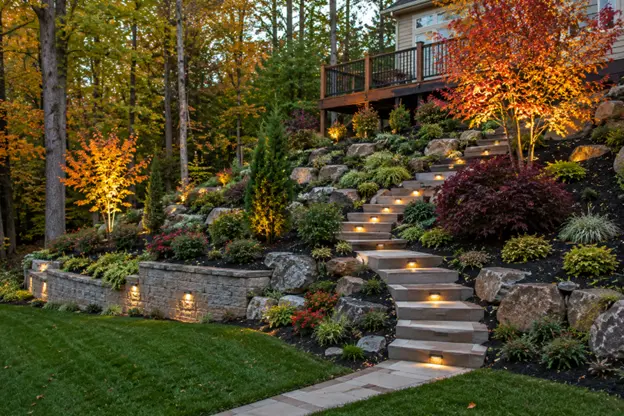
10. Add Stone Steps or a Switchback Path
Walking directly up or down a slope can be difficult and unsafe, especially after rain or when leaves cover the ground. Stone steps, timber steps, or a switchback path can make the slope more usable.
A switchback path follows a gentle zigzag pattern instead of running straight up the hill. This reduces the walking grade and creates opportunities for small planting pockets along the route.
Use durable materials such as:
- Natural stone
- Concrete pavers
- Brick
- Timber with gravel treads
- Precast concrete steps
- Segmental wall blocks
For step construction, keep riser heights consistent and make treads deep enough for secure footing. Add handrails when required or appropriate, particularly on long or steep stairways.
11. Use Permeable Hardscape Materials
Permeable materials can help reduce surface runoff by allowing some water to infiltrate rather than rush downhill.
Consider:
- Permeable pavers
- Open-joint stone
- Gravel
- Decomposed granite
- Porous concrete
- Stepping stones with planted joints
- Stabilized aggregate
Use a properly prepared base that matches the material and site. On sloped areas, edging and base compaction are especially important to prevent gravel and pavers from moving downhill.
12. Use Boulders as Functional Anchors
Boulders can add structure to a sloped yard while helping interrupt the flow of surface water. They create visual weight, provide planting pockets, and can make a hillside feel more natural.
Use boulders to:
- Define terraces
- Frame a dry creek bed
- Create a focal point
- Support small planting areas
- Break up a long slope
- Edge pathways
- Complement native planting
- Add informal seating
13. Improve Soil and Mulch Carefully
Soil health affects how well a slope holds water and supports plants. Compacted soil can cause rain to run off rather than soak in, while bare soil is vulnerable to erosion.
Improve soil where needed by:
- Testing the soil first
- Incorporating compost where appropriate
- Aerating compacted turf
- Avoiding unnecessary tilling on steep slopes
- Adding plants with diverse root systems
- Using mulch around new planting
Keep soil covered year-round with plants, mulch, stone, or erosion-control material. Bare ground is one of the most common causes of hillside washout.
14. Create a Sloped Backyard Seating Area
A slope does not have to eliminate outdoor living. Use terracing or small retaining walls to carve out a level seating area, dining terrace, or fire-pit zone.
A compact outdoor room may include:
- A level paver or gravel pad
- A small retaining wall
- Built-in seating
- Low-voltage lighting
- Privacy planting
- A pergola or shade structure
- Drainage behind walls
- Steps or a switchback path
Place seating areas where water will not collect after storms. A patio should slope gently away from the house and should not block natural drainage routes. These improvements can turn a difficult hillside into one of the most useful landscape solutions for outdoor living.
15. Add Strategic Lighting to the Slope
Lighting improves safety and makes a sloped landscape easier to enjoy after sunset. It is especially useful for steps, paths, terraces, retaining walls, and changes in elevation.
Use lighting for:
- Stone stair treads
- Switchback paths
- Retaining-wall capstones
- Terrace edges
- Garden focal points
- Entry points to the slope
- Seating areas
- Mature trees
Choose low-voltage LED fixtures with shielded, downward-facing light. Avoid placing bright fixtures directly in a person’s line of sight.
Best Plants for Sloped Yards
The exact plants for a slope should be selected locally, but these categories are useful starting points.
Site condition | Helpful plant types | Examples to research locally |
Sunny, dry slope | Drought-tolerant grasses, ground covers, deep-rooted perennials | Yarrow, sedum, creeping juniper, native grasses |
Sunny, moderate-moisture slope | Native grasses, flowering perennials, shrubs | Coneflower, switchgrass, asters, ninebark |
Shady slope | Sedges, ferns, woodland shrubs, shade-tolerant ground covers | Hostas, ferns, carex, creeping phlox |
Wet lower slope | Moisture-tolerant grasses, sedges, rain-garden plants | Native sedges, iris, dogwood, switchgrass |
Steep erosion-prone hill | Dense-rooted natives, spreading shrubs, fast-covering plants | Native grasses, spreading shrubs, ground covers |
Native grasses with deep root systems and sedges with spreading lateral roots can be especially effective at holding soil and reducing erosion.
Common Mistakes to Avoid
Sloped landscapes can be costly to correct if the first installation ignores water, soil, and structural conditions. Avoid these common problems:
- Planting on bare soil without erosion protection.
- Using loose mulch on a steep slope without stabilization.
- Installing a retaining wall without drainage.
- Directing downspouts directly onto a hill.
- Building a patio before correcting grading.
- Removing established vegetation across the entire slope at once.
- Installing smooth or unstable steps.
- Using grass alone on an overly steep grade.
- Placing heavy boulders without stable installation.
- Ignoring property boundaries and drainage rules.
- Building walls that require engineering without professional help.
- Choosing plants based only on appearance rather than site conditions.
The most important principle is to slow, spread, and safely direct water. When water is allowed to rush down bare soil, it will eventually create erosion problems.
Landscape Solutions to Transform Your Sloped Yard This Fall
A sloped yard does not have to be difficult, unsafe, or underused. With the right landscape solutions, you can control erosion, manage water, add usable outdoor space, and create a hillside that looks intentional in every season.
Start with the most urgent priorities: drainage, soil stability, and safe access. Then add planting, paths, terraces, walls, and lighting to turn the slope into a functional part of your outdoor space.
Ready to turn challenging terrain into a beautiful landscape? Contact the experts at Hawkins Landscaping Inc. for a customized, site-specific landscape design plan built around your property’s unique conditions, slope, drainage, and outdoor living goals.
With over 50 years of experience serving Frederick County and surrounding areas, Hawkins Landscaping Inc. can help you choose the right landscape yard ideas, plant materials, drainage solutions, retaining walls, walkways, patios, and other structural features to create a safer, more functional, and attractive outdoor space.
Whether you’re dealing with a sloped yard, poor drainage, uneven terrain, or difficult planting areas, professional planning can help prevent costly mistakes and create a landscape that works naturally with your property.
Call (301) 898-3615 or visit hawkinslandscaping.com to schedule your consultation today. Ask about our flexible financing options and let Hawkins Landscaping Inc. transform challenging terrain into a beautiful outdoor space you’ll enjoy for years to come.