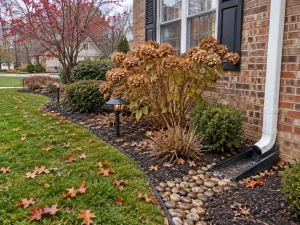
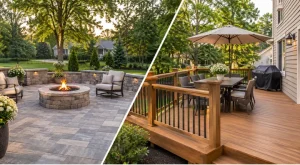
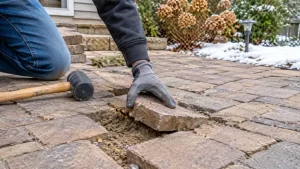
Landscaping with river rock can help manage water runoff when the stone is part of a properly planned drainage system. It can protect vulnerable soil, define a drainage route, and create an attractive transition between planting beds and hard surfaces.
However, river rock does not absorb water or automatically fix poor drainage. The ground beneath it, the shape of the drainage feature, and the destination of the water determine whether the installation works.
The most effective approach is to identify the runoff source, establish a suitable route, and select materials for the actual conditions. Then coordinate planting and decorative details around that function.
This guide explores practical landscaping with river rock ideas, including dry creek beds, downspout discharge areas, planted swales, and maintenance strategies.
How Landscaping With River Rock Fits Into Runoff Management
Landscaping with river rock can serve as a surface treatment within a larger stormwater plan. Depending on the design, it may help protect soil from concentrated flow or provide a durable finish along a water-conveyance route.
Its appearance should not be confused with its performance. Water may travel through the spaces between stones, flow over them, or collect beneath them. What happens next depends on the supporting soil and drainage arrangement.
University of Maryland Extension summarizes residential stormwater management through three principles: slow it down, spread it out, and soak it in where appropriate. Its guidance identifies dry stream beds and engineered swales as possible tools.
River rock can support those strategies, but the stone alone is not the strategy.
1. Identify Where the Water Comes From
Before purchasing materials, observe the property during rainfall when it is safe to do so.
Look for roof discharge, runoff from paving, uphill flow, overflowing gutters, and sediment washing from planting beds.
Photograph the routes and note where water slows, spreads, or collects. Also record whether the problem occurs during ordinary rain or only during unusually intense storms.
University of Maryland Extension explains that hard surfaces increase runoff because they prevent rainwater from soaking into the ground.
The source matters. A rock-lined area receiving one downspout needs a different assessment from a channel collecting water from a large slope.
Avoid choosing a feature simply because it resembles something seen in a photograph. Begin with the water, not the decoration.
2. Separate Drainage Problems From Naturally Damp Areas
Not every wet location needs a rock channel.
A low area that remains damp may be better suited to appropriate planting, while concentrated runoff threatening a walkway or building requires a different response.
Likewise, standing water near a foundation should not be disguised beneath decorative stone.
If water enters the house, erosion exposes structural components, or the problem involves a retaining wall, arrange qualified assessment before making changes.
University of Maryland Extension warns that runoff can damage property and that attempts to correct one property’s flooding may create problems elsewhere.
Define the actual objective: protect soil, convey runoff, encourage suitable infiltration, or address a building-related concern.
Those goals can overlap, but they do not always require the same solution.
3. Create a Dry Creek Bed With a Purpose
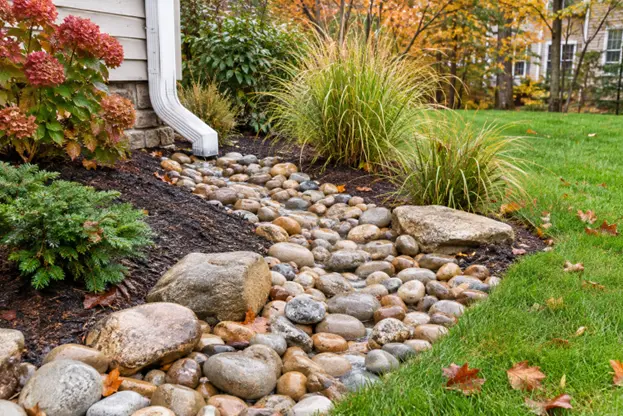
A dry creek bed can provide a natural-looking route for occasional runoff as part of landscaping with river rock.
University of Maryland Extension describes a dry stream bed as a stone-lined channel, often edged with plants, used to redirect water while resembling a natural stream landscape.
Start with the required route and outlet. Then develop the curves, stone arrangement, and planting.
Avoid unnecessary bends that complicate flow or maintenance. A creek bed should look connected to the land rather than like a strip of rock placed randomly across it.
Show where water enters, where it leaves, and what happens during a larger storm.
A feature that ends abruptly beside a fence or building is not complete simply because its visible section looks attractive.
4. Protect a Downspout Discharge Area
Roof runoff is concentrated at downspout outlets. A suitably designed stone area can form part of the transition between the outlet and an appropriate downstream feature.
First confirm that the gutter and downspout work correctly. Do not compensate for a damaged roof-drainage system by spreading more rock below it.
University of Maryland Extension recommends redirecting downspouts toward suitable permeable areas rather than sending water across impervious surfaces.
Its Bay-Wise guidance recommends directing discharge at least 10 feet from the house to help avoid foundation and wet-basement problems. That distance is guidance, not proof that every location will work.
Check slope, soil, overflow, and neighboring property conditions before deciding where the water should go.
5. Combine River Rock With a Planted Swale
A swale is a shallow surface channel designed to manage runoff. Planting and selected stone treatments can be combined where appropriate.
University of Maryland Extension describes vegetated swales as engineered channels that slow stormwater and help remove pollutants.
Do not assume a rock-filled trench performs the same function.
A designer should assess the channel shape, contributing runoff, slope, vegetation, and outlet before incorporating landscaping with river rock. Stone may be appropriate at selected locations rather than across the entire feature.
Keep the design maintainable. Plants should not obscure inspection points, and the route should remain accessible for debris removal.
The best result balances hydraulic function with an appearance that fits the surrounding garden.
6. Use Rock at a Rain-Garden Inlet
A rain garden and a dry creek bed perform different jobs.
A rain garden is a planted depression designed to collect runoff temporarily and allow water to be absorbed into suitable soil. University of Maryland Extension notes that these gardens include planting, soil media, and mulch—not just stone.
A properly designed rock treatment may help organize the inlet, but it should not replace the planted system.
Location and soil suitability require assessment. Do not install an infiltration feature beside the foundation or assume the wettest area is automatically suitable.
The inlet, storage area, soil, plants, and overflow should work together.
River rock is one detail within the design, not a substitute for the rain garden itself.
7. Address Erosion Without Assuming Any Stone Will Work
River rock should not be treated as a universal erosion-control material.
Stone selection must match the expected flow and the intended assembly. Do not assume small decorative pebbles will remain stable wherever runoff concentrates.
Steep routes, significant erosion, and high-energy discharge deserve professional design. An engineered stone-protection system is different from a decorative bed.
University of Maryland Extension identifies check dams as one method of reducing flow velocity, but notes that these are structures installed across channels for a particular purpose.
Do not create improvised dams merely by stacking larger rocks.
Ask how the proposed material and installation will perform during the conditions the system is expected to handle.
Choose the Right River Rock for the Application
Color and shape affect appearance, but functional selection comes first.
Ask the supplier or designer about:
- Suitability for the intended drainage feature
- Stone-size range
- Installation depth and preparation
- Compatibility with planting and edging
- Access for future cleaning
- Availability of matching replacement material
- How the stone will be delivered and handled
Request a specification rather than ordering by a decorative product name alone.
A mix that works beside a patio may not be appropriate within a concentrated-flow channel, so the intended use should guide landscaping with river rock.
For visual consistency, compare samples outdoors beside the house, paving, and existing stonework.
Use a restrained palette so the drainage feature feels integrated rather than becoming the dominant object in the yard.
River Rock, Gravel, and Plants Serve Different Roles
These materials are not interchangeable.
Material or Feature | Potential Role | Important Limitation |
Decorative river rock | Surface finish within a planned feature | Does not establish drainage by itself |
Specified drainage aggregate | Component of a designed assembly | Must match the system |
Larger engineered stone | Protection at suitable high-energy locations | Requires appropriate sizing and installation |
Vegetated swale | Slows and conveys runoff | Needs suitable geometry, planting, and maintenance |
Rain garden | Temporarily stores and infiltrates runoff | Requires suitable location, soil, and overflow |
Mulch | Planting-bed cover | Must suit the location and expected water movement |
University of Maryland Extension distinguishes conveyance features, vegetated swales, and rain gardens rather than presenting them as one interchangeable solution.extension.
Plan the Ground Beneath the Rock
The visible surface is only part of the installation when landscaping with river rock.
Ask what excavation, grading, subgrade preparation, and separation materials are required for the chosen design.
Do not automatically add landscape fabric, sand, or a deep layer of stone because those materials appear in a generic tutorial.
Whether a geotextile or other layer is appropriate depends on the purpose and assembly. Ask what it is intended to do and how the system will be maintained.
Also clarify whether the feature is designed primarily to convey water or encourage infiltration.
The answer influences the construction approach.
A decorative finish cannot correct an unsuitable slope, obstructed outlet, or underlying soil condition that was never assessed.
Give Runoff an Appropriate Destination
Every drainage feature needs a destination and an overflow plan.
The water may be directed toward a suitable planted area, a properly designed stormwater feature, or another approved discharge point.
Do not send it onto neighboring land or connect to a drainage system without confirming permission and requirements.
University of Maryland Extension warns that changes intended to fix flooding can create problems for adjacent properties.
Ask the contractor to show the complete route on a plan.
Also discuss what happens when rainfall exceeds the system’s intended capacity.
Overflow should be considered before construction rather than discovered when the first large storm sends water across a patio or toward the house.
Integrate the Feature Into Your Landscaping Design
Functional drainage can still look intentional.
Repeat stone colors already present in the property. Use planting to soften selected edges while preserving the route and maintenance access.
A dry creek bed may connect the visual language of a stone patio, garden border, and planted slope.
Keep scale in mind. A narrow decorative ribbon can look out of place in a broad yard, while an oversized rock feature may overwhelm a compact garden.
Do not force a natural stream appearance where a simpler planted drainage feature would fit better.
The strongest landscaping design begins with function and then uses proportion, repetition, and planting to make that function feel at home.
Practical Landscaping Ideas for Different Areas
Along a Side Yard
Maintain clear access and assess how nearby buildings affect runoff. Avoid creating a channel without understanding the downstream destination.
Beside a Patio
Use stone selectively to connect paving and planting, but investigate settlement or recurring puddles before treating the edge decoratively.
Below a Downspout
Coordinate the outlet, transition area, and receiving landscape. The rock treatment should not end where the larger drainage problem begins.
Through a Garden
A dry creek bed can become a visual connection between planting areas when its route serves an actual purpose.
On a Slope
Seek professional guidance where flow, erosion, or instability makes the project more than a small decorative installation.
Maintenance Matters More Than the “Low-Maintenance” Label
Rock features still collect leaves, sediment, weeds, and other debris.
Inspect the system after significant storms. Look for displaced stone, blocked inlets, sediment buildup, erosion, and unexpected overflow.
University of Maryland Extension documents a demonstration-garden rock swale that became clogged with silt and debris. The blockage contributed to erosion and flooding until the rocks were removed, the channel cleaned, and the system restored.
That example shows why landscaping with river rock should not be marketed as maintenance-free.
Preserve access for cleaning and budget for periodic work.
A feature that cannot be inspected or cleared conveniently may become a recurring problem even if it performed well initially.
Common Mistakes to Avoid
The most frequent mistake is placing rock where water collects without investigating why.
Other problems include:
- Assuming water will soak through any underlying soil.
- Building a channel with no suitable outlet.
- Using decorative material where engineered protection is needed.
- Blocking an existing drainage route.
- Directing runoff toward a neighbor.
- Hiding foundation concerns under stone.
- Neglecting sediment removal.
- Selecting appearance before function.
University of Maryland Extension emphasizes slowing, spreading, and soaking in runoff where appropriate—not simply moving it as quickly as possible to another location.
A successful project should explain which of those goals it serves.
Budget for the Complete System
The rock itself may be only one part of the cost.
A complete proposal may include assessment, design, approvals, excavation, soil disposal, specified materials, planting, outlet work, and restoration.
Ask whether the estimate covers the entire drainage route.
Compare equivalent scopes rather than material quantities alone.
A lower price that omits an appropriate outlet or important preparation may not represent the same solution.
If work must be phased, establish the overall plan first. Avoid finishing decorative areas that later need removal for drainage construction.
Prioritize diagnosis, safe routing, and maintainability before adding ornamental boulders or complex planting.
Know When to Hire a Professional
Seek qualified help for water entering a building, substantial erosion, steep drainage routes, retaining-wall concerns, or uncertain discharge rights.
Before excavation, arrange applicable utility locating and confirm required approvals.
Request a written assessment explaining:
- The runoff source
- The proposed feature’s purpose
- Material and construction specifications
- The destination and overflow route
- Expected maintenance
- Project limitations
- Responsibilities for specialist work
Avoid promises that river rock will permanently eliminate flooding.
A responsible contractor explains what the installation can address and what remains outside its scope.
Landscaping With River Rock for Runoff Management
Landscaping with river rock works best when attractive stone supports a clearly defined water-management plan.
Start by observing rainfall, identifying the source, and deciding whether the site needs conveyance, erosion protection, suitable infiltration, or a combination.
Ready to improve your yard while adding natural beauty to your landscape? Hawkins Landscaping Inc. can help you explore practical landscaping solutions that combine attractive materials with functional outdoor design. Whether you want to refresh planting beds, define garden borders, or improve areas affected by runoff, thoughtful planning can make your property more appealing and manageable.
Incorporating river rock into your landscaping design can add texture, create visual contrast, and complement plants, walkways, and other hardscape features. The right landscaping ideas should also consider grading, water flow, soil conditions, and access for future maintenance. While decorative stone can support a drainage plan, proper grading and professionally designed drainage features may still be needed to manage excess water effectively.
With over 50 years of experience serving Frederick County and surrounding areas, Hawkins Landscaping Inc. can help you create a landscape that balances natural beauty, functionality, and long-term maintenance.
Ready to refresh your landscape? Call (301) 898-3615 or visit hawkinslandscaping.com to schedule your consultation. Ask about our flexible financing options for your outdoor project