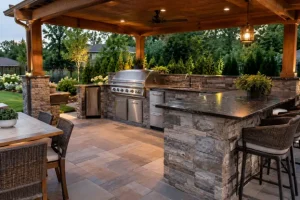
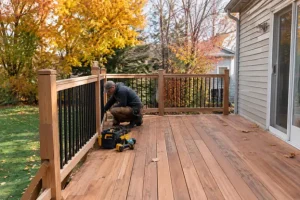
October evenings have a special atmosphere. The strongest summer heat has faded, the air feels cooler, and the backyard becomes a comfortable place for outdoor dinners, conversations, and quiet time after sunset. The right outdoor patio lights can help you enjoy that season longer by making the space safer, warmer, and more visually inviting.
A successful lighting plan is about more than hanging one string of bulbs. The best patio ideas for backyard spaces use layers of light. Path lights guide people safely, task lights help with cooking and serving, ambient lights create comfort, and accent lights highlight trees, planters, walls, and garden features.
This guide covers outdoor patio lighting ideas, fixture types, layout strategies, safety tips, installation planning, fall maintenance, and professional patio installation considerations. It is designed to provide detailed, useful information for homeowners planning a October patio upgrade.
Why Patio Lights Matter in October
October brings shorter days and earlier sunsets. A patio that feels welcoming at 7 p.m. in July may be dark by the time dinner begins in early fall. Without lighting, stairs, uneven pavers, garden paths, and patio edges can become difficult to see.
Outdoor patio lights can improve:
- Safe movement around steps and walkways
- Visibility near grilling and food-preparation areas
- Comfort during outdoor meals
- Evening curb appeal
- Patio use after sunset
- Visibility around fire pits and seating areas
- Garden views from the patio
- Security near doors and gates
- The overall feeling of an outdoor room
Low-voltage, LED, solar, and plug-in lighting options give homeowners flexibility for different budgets and patio sizes. Outdoor lighting guides note that low-voltage, solar, and LED fixtures can help illuminate patios, decks, gardens, and walkways while using less energy than older systems.
The best lighting setup does not make the patio look like a parking lot. It uses gentle, controlled illumination so people can see where they are going while still enjoying the fall evening atmosphere.
Begin With a Lighting Plan
Before buying fixtures, walk through the patio after dark. Bring a flashlight and take notes about the areas that feel unsafe, too dark, or visually flat.
Look for:
- Patio steps
- Changes in elevation
- Walkways to the house
- Grill and outdoor kitchen areas
- Outdoor dining tables
- Fire-pit paths
- Gates
- Garden edges
- Retaining walls
- Deck railings
- Dark corners near storage areas
- Furniture that blocks routes
- Existing outlets
- Potential mounting points
Then divide the patio into lighting zones. Most outdoor spaces need some combination of task, ambient, accent, and safety lighting.
Task lighting is brighter and more focused. It is useful near grills, prep counters, outdoor kitchens, dining tables, and doorways.
Ambient lighting creates the overall glow. It may include string lights, sconces, pendants, lanterns, or soft overhead lighting.
Accent lighting draws attention to features such as trees, stone walls, ornamental grasses, water features, or planters.
Safety lighting reveals pathways, stairs, deck edges, and changes in grade.
A clear layout for patio lights should be planned before purchasing fixtures. Garden-lighting installation guidance recommends mapping the desired arrangement, measuring distances, identifying safe mounting points, and verifying available power sources before installation begins.
1. Hang String Lights Over the Patio
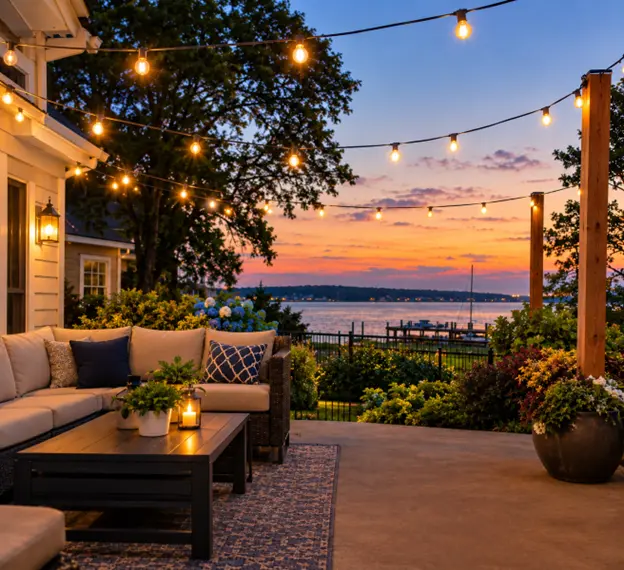
String lights are among the easiest and most popular outdoor patio lights. They create a warm, relaxed atmosphere and can make even a basic concrete patio feel like an outdoor dining room.
String lights work well when installed:
- Across a pergola
- Between patio posts
- Along a fence
- Between trees
- Under a covered porch roof
- Over an outdoor dining table
- Along a deck railing
- Around a gazebo
- Across a fire-pit seating area
For a polished appearance, choose outdoor-rated LED string lights with weather-resistant sockets and shatter-resistant bulbs. Warm-white bulbs generally create the most inviting glow for patios.
Before installation, measure the patio and decide on a layout. Common patterns include a zigzag, perimeter outline, parallel lines, or a central starburst pattern.
For long spans, do not rely only on the electrical cord to support the weight of the lights. Use a guide wire or cable anchored to secure posts, beams, or exterior walls. The lights can then be attached to the cable with clips or ties.
2. Add Low-Voltage Path Lights
Path lights improve safety and help guests move from the house to the patio, deck, fire pit, garden, or side gate. They are especially useful in October when leaves, shadows, and earlier darkness can hide the edges of a walkway.
Use path lights along:
- Main patio access routes
- Garden paths
- Driveway-to-patio routes
- Side-yard walkways
- Fire-pit paths
- Gravel routes
- Stepping-stone paths
- Patio borders
Low-voltage path lights typically operate on a 12-volt system connected to a transformer. They can be more consistent than solar fixtures and are usually suitable for permanent landscape lighting plans.
Do not place every light directly opposite another fixture. Staggering lights on alternating sides of a path usually creates a more natural look and reduces the appearance of a bright runway.
3. Illuminate Patio Steps
Steps are one of the most important places to add outdoor lighting. A small change in elevation can become a safety issue after dark, especially when rain, leaves, frost, or shadows cover the edge.
Use:
- Riser lights
- Under-tread LED strips
- Side-mounted step lights
- Post-cap lights
- Railing lights
- Low wall lights
- Recessed deck lights
Step lighting should be low and shielded. The goal is to make the tread and edge visible without shining directly into someone’s eyes.
Install lighting at both the top and bottom of longer stairways. If the patio includes multiple levels, light every change in grade rather than assuming one nearby fixture is enough.
4. Use Wall Sconces Near Doors
Wall sconces provide valuable task and security lighting near patio doors, side entrances, garage entries, and outdoor kitchens. They are particularly useful when people carry food, drinks, bags, or firewood outside after dark.
A wall sconce should:
- Illuminate the lock and handle
- Reveal the threshold
- Provide light on nearby steps
- Complement the home’s architecture
- Avoid shining directly into guests’ eyes
- Work with the other patio fixtures
Choose an exterior-rated fixture with a warm LED bulb. Match the finish to visible exterior hardware, such as door handles, house numbers, railings, awning frames, or outdoor furniture.
5. Add Pergola and Covered Patio Lighting
Pergolas, covered patios, gazebos, and pavilions provide natural mounting points for patio lights. They can support pendants, string lights, recessed fixtures, ceiling fans with lighting, lanterns, and LED strips.
For a pergola dining zone, a pendant-style fixture or string-light canopy can define the table. For a lounge area, use dimmable overhead lights combined with portable lanterns and nearby landscape lighting.
Popular pergola and covered-patio lighting options include:
- String lights along beams
- Recessed downlights
- LED strips beneath rafters
- Pendant lights over dining tables
- Wall sconces near doors
- Lanterns mounted on posts
- Outdoor ceiling fans with lights
- Low-voltage lights beneath railings
Do not attach heavy lights, hanging planters, speakers, or decorative items to an awning frame or retractable canopy unless the manufacturer specifically approves it. A retractable awning is a shade system, not a structural beam.
6. Install Task Lighting for Grilling and Cooking
A grill may be enjoyable during the day but frustrating after dark without proper lighting. Task lighting is essential for outdoor kitchens, grill stations, prep counters, beverage areas, and serving tables.
Good task lighting options include:
- Grill-handle lights
- Overhead pendants
- Wall-mounted fixtures
- Under-counter LEDs
- Magnetic LED grill lights
- Adjustable spotlights
- Outdoor-rated work lights
- Cabinet lights
- Path lights near the cooking route
Place the light so it illuminates the grill grate and prep surface without shining directly into the cook’s eyes. Avoid positioning lights where they create harsh shadows from the cook’s body or lid.
Use fixtures rated for outdoor heat and moisture conditions. Keep cords away from hot surfaces, grease, water, and walking paths.
7. Highlight Trees and Garden Features
Accent lighting can turn a patio view into a nighttime landscape. Use uplights, spotlights, and downlights to highlight selected plants and structures.
Good focal points include:
- Mature trees
- Ornamental grasses
- Water features
- Stone walls
- Sculptural shrubs
- Garden art
- Large planters
- Pergola posts
- Retaining walls
- Architectural details
- Fall foliage
Use one or two carefully placed fixtures rather than lighting every plant. Contrast between lit and unlit areas creates depth and makes the patio feel more expansive.
Uplighting works well for a tree trunk, ornamental grass, wall, or boulder. Place the fixture a short distance from the feature and angle it upward. Avoid aiming lights toward windows, neighboring properties, or a seating area where glare may be uncomfortable.
Downlighting, sometimes called moonlighting, can be mounted in a tree or high structure to cast a soft pattern of light over a patio or path. Lighting designers often use this technique to create a natural effect on decks, patios, and garden seating areas.
8. Use Portable Lanterns and Rechargeable Lamps
Portable lighting is one of the easiest ways to create a beautiful October patio without permanent wiring. Rechargeable lamps, tabletop lanterns, flameless candles, and battery-powered fixtures can be moved where needed.
Use portable lights on:
- Dining tables
- Side tables
- Outdoor bars
- Fire-pit seating
- Swing chairs
- Porch steps
- Garden benches
- Beverage stations
- Outdoor rugs
These lights should supplement, not replace, path and step lighting. A portable lantern may make a table look inviting, but it will not make stairs or uneven pavers safe.
Choose weather-resistant products designed for outdoor use. Bring portable lamps indoors during severe weather or long periods of rain.
9. Add Deck, Rail, and Wall Lighting
Deck rails, seating walls, retaining walls, and patio borders can benefit from integrated lighting. These fixtures create subtle guidance and make the patio feel finished.
Use:
- Post-cap lights
- Under-rail LED strips
- Recessed deck lights
- Retaining-wall cap lights
- Seat-wall lights
- Low wall fixtures
- Recessed paver lights
- Edge lights
Under-rail lighting provides soft illumination without visible glare. It works especially well around deck stairs and raised patios.
Wall lights installed beneath capstones can make retaining walls and seating walls more visible while also improving safety near changes in elevation.
10. Use Smart Controls and Timers
Smart controls make patio lights easier to use and can reduce energy waste. Instead of manually turning lights on every evening, use timers, photocells, dimmers, motion sensors, or app-based controllers.
Useful options include:
- Dusk-to-dawn photocells
- Astronomical timers
- Smart outlets
- App-controlled transformers
- Dimmable fixtures
- Motion sensors
- Remote controls
- Voice-controlled switches
- Zone-based lighting controls
An astronomical timer adjusts lighting schedules based on local sunset times, which is useful as October days become shorter. You can set path lights to turn on at dusk, keep dining lights available for a few hours, and turn accent lighting off later in the evening.
Patio Lighting Safety Tips
Safety should guide every lighting decision.
- Use only fixtures, bulbs, cords, connectors, and mounting hardware rated for exterior use when installing patio lights. Exterior-rated products are designed to handle moisture, temperature changes, and ultraviolet exposure better than indoor items.
- Use GFCI-protected outlets where required. Do not overload outlets or connect too many light strands beyond the manufacturer’s recommended maximum.
- Keep cords away from walkways, stairs, grills, water features, and fire pits. Do not run extension cords under rugs where they can overheat or become damaged.
- Mount fixtures securely. String-light anchors should be attached to stable posts, walls, pergola beams, or other approved structural points. For long spans, use guide wire so the electrical cord does not carry all the weight.
- Home improvement guidance recommends measuring string-light routes, using secure hooks or anchors, and avoiding staples or fasteners that can puncture electrical cords.
- Turn off power before working on wiring. If you are uncertain about electrical load, outdoor ratings, GFCI protection, or wire burial, hire a qualified professional.
Common Patio Lighting Mistakes
- Avoid using one extremely bright fixture to light the entire patio. This often creates glare and makes the space feel harsh.
- Avoid placing path lights too close together. Too many lights can make a walkway look like a runway rather than a garden path.
- Do not ignore steps. Lighting a patio table is not enough if guests cannot safely walk to the house.
- Avoid using indoor extension cords or fixtures outside. They are not designed for moisture and can create electrical hazards.
- Do not install string lights without measuring. A strand that is too short creates tension, while one that is too long may sag into head height or furniture.
- Avoid overlighting trees, walls, and gardens. One or two focal points often create more beauty than lighting every feature.
- Do not install lighting before thinking about future patio design. If you may add a pergola, outdoor kitchen, retaining wall, or path later, plan conduit and electrical access now.
When to Hire a Professional
Simple plug-in string lights, solar accents, portable lanterns, and rechargeable lamps are suitable for many homeowners. More complex patio installation projects benefit from professional help.
Hire a professional for:
- Hardwired patio lighting
- Low-voltage system design
- Tree-mounted downlights
- Outdoor kitchen task lighting
- Lighting integrated into retaining walls
- Deck and stair lighting
- Electrical work near water
- Smart lighting systems
- Large pergola lighting
- New outdoor outlets
- Trenching and conduit work
- Complex patio renovations
A landscape lighting or electrical professional can create a plan for patio lights that balances safety, fixture quality, glare control, power needs, and the overall patio design.
Make October Evenings Brighter With Patio Lights
Outdoor patio lights can transform a basic backyard into a warm, usable space for October dinners, quiet evenings, fall gatherings, and weekend entertaining. Start with the essentials: safe path lights, visible steps, a well-lit cooking area, and warm ambient lighting around seating.
Then add the details that make your patio feel personal, such as string lights, lanterns, uplighted trees, illuminated planters, or a softly lit pergola.
Ready to upgrade your outdoor space? The right combination of patio design and landscape lighting can make your backyard more comfortable, functional, and inviting after sunset. Start by considering how you want to use the space and where lighting can improve visibility, highlight features, and create a relaxing atmosphere.
At Hawkins Landscaping Inc., we can help turn your patio ideas for backyard spaces into a cohesive outdoor retreat. From a customized patio design and professional patio installation to task, safety, ambient, and accent lighting, our team can coordinate the details so your patio looks great and works well into the evening.
With thoughtful planning, durable materials, and properly placed lighting, your patio can remain a welcoming place for outdoor dining, relaxing, and entertaining long after the October sun goes down.
Ready to bring your patio vision to life? Call (301) 898-3615 or visit Hawkins Landscaping Inc. to schedule your consultation. Ask about flexible financing options for your outdoor project.