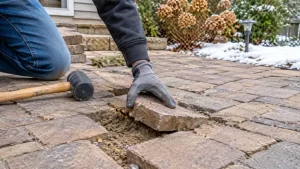
A well-built ground-level patio is generally easier to maintain in a patio vs deck comparison than a traditional wood deck because it does not require recurring wood refinishing or the same elevated structural inspections. However, the comparison becomes closer when you consider composite decking, which avoids much of the surface-finishing work associated with wood.
Neither option is maintenance-free. Patios need cleaning, drainage checks, and material-specific repairs. Decks need cleaning plus attention to their framing, connections, stairs, and railings.
In the patio vs deck decision, the material and installation quality matter as much as the type of outdoor space. Your property’s slope, weather exposure, surrounding vegetation, and furniture also influence the workload.
This guide compares the most important maintenance tasks and explains how to choose an outdoor space that fits your routine.
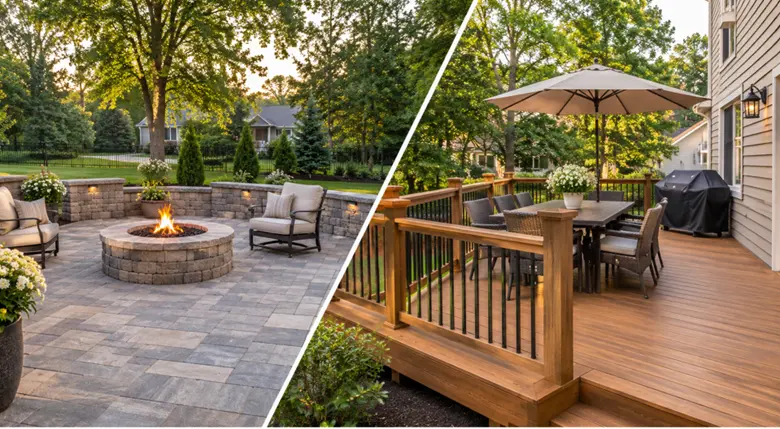
Patio vs Deck: The Quick Comparison
For this article, a patio means a ground-level paved outdoor area. A deck means a framed outdoor platform, whether close to the ground or elevated.
That distinction matters in a patio vs deck comparison because a roof terrace or elevated paved structure has different maintenance requirements from a conventional backyard patio.
Maintenance Factor | Ground-level Patio | Wood Deck | Composite Deck |
Routine cleaning | Sweeping and material-appropriate washing | Sweeping and wood-appropriate cleaning | Manufacturer-approved cleaning |
Surface treatments | Depend on material and intended appearance | Recurring finish maintenance may be needed | Routine wood staining generally avoided |
Common concerns | Settlement, joint loss, cracks, drainage | Weathering, splinters, decay, loose components | Stains, scratches, product-specific damage |
Structural attention | Supporting ground and any associated walls or steps | Framing, supports, connections, stairs, guards | Same structural categories as other framed decks |
Landscaping interaction | Soil, mulch, roots, and runoff | Vegetation and debris around or beneath framing | Similar access and debris concerns |
Concrete Masonry & Hardscapes Association (CMHA) provides maintenance guidance for patio paving systems, while the American Wood Council recommends regular professional inspection of decks, especially elevated ones.
What Makes an Outdoor Space “Easy to Maintain”?
Maintenance includes more than sweeping leaves or washing a surface.
Separate the work into four categories:
- Routine chores, such as removing debris and spills.
- Seasonal tasks, including furniture storage and winter preparation.
- Preventive work, such as finish care and drainage checks.
- Repairs and inspections involving paving or structural components.
A patio may have fewer recurring surface treatments but still require attention if it settles or collects water.
A composite deck may be easy to wash, yet its framing and connections still need evaluation.
Think about the work you want to avoid. Some homeowners dislike painting and staining. Others want fewer joints to clean or less heavy furniture to move.
The right choice should reduce the tasks that are most inconvenient for you.
1. Everyday Cleaning: The Difference Is Often Smaller Than Expected
Both patios and decks collect dirt, leaves, pollen, food residue, and other debris.
Size and surroundings often influence the cleaning workload more than the label. A small deck away from trees may need less attention than a large patio beneath a dense canopy.
For interlocking concrete paving, Concrete Masonry & Hardscapes Association (CMHA) recommends spring sweeping to remove leftover winter material and fall sweeping to clear accumulated leaves and dirt. It also cautions against removing joint sand during cleaning.
Trex recommends appropriate cleaning for its composite products, including soap-and-water cleaning for certain product lines. Instructions differ between newer and earlier-generation materials.
Avoid applying one cleaning method to every surface. Identify the product before choosing chemicals, brushes, or pressure-washing settings.
2. Wood Decks Add a Surface-Finishing Commitment
Traditional wood decking usually involves more recurring surface care than a conventional patio.
The USDA Forest Products Laboratory explains that suitable finishes can reduce weathering problems such as cracking, raised grain, and mildew. It recommends penetrating finishes for wood decks and notes that these are generally easier to reapply than film-forming finishes
That does not mean every wood deck should receive the same coating on a fixed schedule.
Wood species, previous finishes, sun exposure, moisture, and the selected product all affect maintenance.
Ask what preparation is required before recoating and how you should determine when the finish needs attention.
Do not assume pressure-treated lumber needs no surface care. The Forest Products Laboratory notes that treated lumber and naturally durable woods still benefit from appropriate moisture-management and finish maintenance.
3. Composite Decking Reduces Some Work, Not All Work
Composite decking can simplify maintenance by avoiding the recurring wood-staining routine.
However, it is not immune to dirt, staining, scratching, or inappropriate cleaning.
Trex distinguishes care requirements for its earlier-generation composites from those of newer high-performance products. Its guidance also cautions that some rubber-backed mats can discolor or lighten the decking surface.
Before buying, request the care guide for the exact product—not just general advice about composite materials.
Confirm instructions for food spills, furniture protection, snow removal, and cleaning equipment.
Also remember that the visible boards are only part of the deck. Choosing composite decking does not eliminate maintenance of the frame, stairs, railings, and connections supporting the outdoor space.
4. Patio Pavers Need Joint and Edge Attention
Paver patios avoid wood refinishing, but their joints and perimeter remain important.
Inspect for missing joint material, shifting units, spreading edges, and localized settlement.
Concrete Masonry & Hardscapes Association (CMHA) explains that joint sand can be lost through wind, runoff, and excessive cleaning. Its maintenance guidance recommends replenishment when conventional joint sand falls sufficiently below the intended level.
The correct replacement material depends on the system.
Do not automatically add ordinary sand to permeable paving. CMHA specifically distinguishes permeable installations, which use joint aggregate that must remain suitable for infiltration.
A useful patio maintenance plan should identify the paving type, joint material, edge restraint, and cleaning requirements.
The word “pavers” alone does not provide enough information.
5. Sealing a Patio Is Not Automatically an Annual Task
One common misconception is that every patio needs regular sealing.
Whether a sealer is appropriate depends on the material, desired appearance, exposure, and manufacturer’s instructions.
CMHA describes sealers and joint stabilizers as optional treatments in its construction guidance, rather than universal requirements.
If sealing is proposed, ask what problem it addresses. Will it change color, sheen, cleaning requirements, or traction? What future preparation will be needed?
Repairs and cleaning should come first.
CMHA’s sealing guidance emphasizes removing stains and dirt and ensuring suitable drying conditions before application.
A sealer should not be presented as a cure for settlement, poor drainage, or unsuitable construction.
6. Structural Maintenance Is a Major Difference
A ground-level patio and an elevated deck have fundamentally different support systems, making this an important consideration in a patio vs deck comparison.
A patio typically transfers use loads through paving and supporting layers to the ground. A deck relies on framing, supports, connections, and other structural components.
The American Wood Council recommends regular inspection by a qualified inspector or construction professional, particularly for elevated decks. Its guidance highlights the importance of the deck-to-house connection and moisture protection at the ledger.
This applies even when the surface boards appear attractive.
Do not judge a deck’s condition solely by how clean it looks.
If you notice movement, loose railings, deterioration, or concerns near the house connection, arrange professional assessment rather than attempting a cosmetic repair.
7. Drainage Matters for Both Options
Neither space stays low-maintenance when water management is neglected.
For patios, look for recurring puddles, washed-out joints, and runoff that carries soil or mulch across the surface.
For decks, keep debris from accumulating where it prevents drainage or drying. Pay particular attention to areas near the building and other moisture-sensitive details.
The Forest Products Laboratory emphasizes moisture control as a central part of wood-deck durability. Suitable water-repellent finishes reduce liquid-water absorption, although they do not make wood completely waterproof.
Do not assume a gap between boards solves every moisture problem.
For either option, have recurring water issues evaluated before investing in decorative upgrades.
8. Repairs Have Different Trade-Offs
Patio repairs may involve replacing individual paving units, correcting a supporting layer, restoring joints, or addressing cracks.
Deck repairs may involve boards, fasteners, railings, stairs, framing, or connections.
In a patio vs deck comparison, the visible damage does not always reveal the full scope.
A rocking paver may require a localized correction—or indicate a wider supporting-layer problem. A damaged deck board may be replaceable, but deterioration below it could change the repair.
Ask the contractor to explain the cause before approving the solution.
Avoid comparing only the cost of replacing one paver with one board. Access, matching materials, concealed conditions, and restoration all affect the work.
A maintenance-friendly design allows important components to be inspected and serviced without unnecessary demolition.
9. Winter Care Requires Material-Specific Choices
Snow and ice maintenance should follow the product’s guidance.
For certain Trex composite products, the manufacturer recommends plastic shovels rather than metal ones and advises moving with the direction of the boards to reduce damage. Its guidance permits specified deicers for those products.
Do not extend that advice automatically to every decking or patio material.
For concrete pavers, CMHA recommends seasonal cleaning and distinguishes permeable systems from conventional paving when discussing sand and winter maintenance.
Plan where snow will go before storms arrive.
Keep access routes, stairs, drains, and doors usable. A low-maintenance surface still requires a workable winter routine.
10. Patio Furniture Can Create More Work Than the Surface
A large collection of patio furniture adds cleaning, moving, covering, and storage tasks regardless of what sits beneath it.
Before choosing a layout, consider:
- How many seats you actually use.
- Whether cushions need protected storage.
- How easily furniture can be moved for cleaning.
- Whether legs or mats are compatible with the surface.
- How covers will be secured.
- Whether drains and service points remain accessible.
For composite decking, check the manufacturer’s advice before using rubber-backed mats or other accessories that may affect the finish.
A simple dining arrangement can be easier to maintain than an elaborate lounge area on either surface.
Buy for your routine rather than filling every available square foot.
11. Installation Quality Influences Future Maintenance
A well-selected material can still perform poorly when installation is unsuitable.
For a patio, discuss excavation, supporting layers, drainage, edge restraint, and transitions.
For deck installation, discuss the full structural system, including supports, framing, connections, moisture protection, stairs, and guards.
Confirm applicable permits, inspections, and contractor qualifications for your location.
Ask for product-specific maintenance instructions at handover.
CMHA’s construction guidance calls for cleaning, sealing, and joint stabilization work—where required—to follow manufacturer recommendations. The same principle applies broadly: construction and ongoing care should be coordinated.
The cheapest initial proposal is not necessarily the easiest space to maintain.
Compare complete scopes rather than surface materials alone.
A Low-Maintenance Patio Idea: Keep the Layout Purposeful
One practical patio idea is to build only the area you will regularly use.
Create a comfortable dining or seating zone, preserve a clear route to the house, and limit awkward corners that collect debris.
Coordinate planting so soil and mulch do not routinely spill across the surface.
Choose a paving system appropriate to the site and keep access to drains and edges straightforward.
Avoid adding a border, fire feature, or outdoor kitchen simply because space allows it. Every feature creates additional cleaning and service needs.
A smaller, thoughtfully arranged patio can provide more everyday value than a large area used mainly to store furniture.
A Lower-Maintenance Deck Idea: Simplify Beyond the Boards
Choosing composite boards may reduce surface-finishing work, but layout still matters.
Keep stairs and circulation practical. Avoid filling the space with planters and accessories that make cleaning and inspection difficult.
Discuss railings, lighting, furniture compatibility, and under-deck access before construction.
Make sure the maintenance plan covers the whole structure.
For wood decking, choose a finish strategy you are willing to maintain rather than one selected only for its initial appearance.
The Forest Products Laboratory notes that penetrating finishes generally simplify recoating compared with film-forming systems.
A straightforward design with clear care instructions is often more useful than a complex structure marketed as effortless.
Compare Long-Term Costs Without Guessing
It is tempting to assign a universal yearly maintenance cost in a patio vs deck comparison, but that can be misleading.
Labor rates, area, materials, exposure, age, and condition vary.
Request a comparison covering:
Cost Category | What To Ask |
Routine cleaning | DIY requirements or professional service frequency |
Surface treatments | Whether needed and how renewal is assessed |
Inspections | Which components require professional review |
Repairs | Typical access and replacement considerations |
Furniture care | Storage, covers, cleaning, and replacements |
Installation | Complete scope, not just visible materials |
Do not assume that a lower-maintenance material will eliminate repair costs.
A written care plan helps you compare realistic commitments instead of relying on broad sales claims.
Which Option Fits Your Property?
A patio may be a strong choice when your yard provides suitable ground-level space and you want to avoid wood refinishing and elevated framing, making it an appealing option in a patio vs deck comparison.
A deck may suit a home where the main living area is above the yard or where the site calls for a raised outdoor connection.
Those are planning considerations, not reasons to force one option onto every property.
Ask a qualified professional to evaluate elevation changes, drainage, access, and the relationship to the house.
The easiest space to maintain is often the one that works naturally with the site rather than requiring extensive workarounds.
Patio vs Deck: Which Outdoor Space Is Right for Your Home?
For most homeowners comparing a conventional patio with a traditional wood deck, the patio offers fewer recurring surface-care tasks. Composite decking narrows that difference, but structural maintenance remains important. That distinction is central to the patio vs deck decision.
Ready to upgrade your outdoor living space? Hawkins Landscaping Inc. can help you explore attractive and functional options for your backyard, whether you prefer a beautiful patio or a custom deck. Our team can help you plan a design that considers your property’s layout, drainage, accessibility, and long-term maintenance needs.
When comparing a new patio idea with a professional deck installation, consider construction requirements, inspections, surface care, and future repairs. The right deck design or patio layout should complement your home while providing enough room for comfortable patio furniture and everyday outdoor activities.
With over 50 years of experience serving Frederick County and surrounding areas, Hawkins Landscaping Inc. can help you create an outdoor space that fits your lifestyle without adding unnecessary maintenance.
Ready to plan your outdoor upgrade? Call (301) 898-3615 or visit hawkinslandscaping.com to schedule your consultation. Ask about our flexible financing options for your outdoor project.