Once Halloween ends, your front yard can feel caught between seasons, making landscaping front yard ideas for a simple seasonal refresh especially useful. Pumpkins begin to soften, decorations leave gaps in planting beds, and colorful displays give way to fallen leaves and quieter garden colors.
The best way to refresh the space is not to replace every Halloween decoration with another seasonal purchase. Start by clearing the entrance, assessing existing plants, defining garden edges, and choosing a few improvements that will look attractive throughout late fall and winter.
Thoughtful landscaping design combines appearance with everyday function. A refreshed front yard should welcome guests, keep walking routes convenient, and complement your home without creating unnecessary maintenance.
This guide shares practical landscaping ideas for the post-Halloween transition, including planting, containers, lawn care, pathways, and landscaping lights.

Landscaping Front Yard Ideas for a Post-Halloween Refresh
With Halloween decorations removed, it’s time to focus on improvements that make your front yard look organized, welcoming, and ready for the colder months. The following landscaping tasks can help refresh your outdoor space while keeping maintenance manageable.
1. Start With a Complete Post-Halloween Reset
Before adding anything new, remove decorations that no longer belong in the space. Take down artificial cobwebs, collect stakes, disconnect temporary lighting, and remove damaged pumpkins.
Work through the yard systematically: doorway, porch, walkway, lawn, then planting beds. This prevents small items from disappearing beneath leaves.
Separate reusable decorations from damaged pieces and organic material. Check local collection or composting guidance before disposing of painted, coated, or otherwise decorated pumpkins.
Clean the entrance and assess what remains. You may discover that a crowded porch needs fewer accessories, not a replacement display.
Take photographs from the street and front door. An uncluttered view makes it easier to identify where the yard needs definition, balance, or repair.
Treat this cleanup as the beginning of your design process rather than a task to rush through.
2. Identify What the Front Yard Needs Most
A successful refresh solves a specific problem, and the best landscaping front yard ideas start with identifying what needs attention.
Perhaps the entrance is difficult to see, the foundation bed looks disconnected from the walkway, or seasonal containers are the only source of interest.
Write down three priorities before shopping. Examples include:
- Create a clearer connection between the driveway and entrance.
- Replace scattered decorations with a coordinated container arrangement.
- Improve nighttime visibility along steps.
- Simplify an overcrowded planting bed.
- Add plants that remain visually useful after flowers fade.
Distinguish immediate maintenance from longer-term work. Clearing leaves and rearranging containers can happen quickly. Drainage correction, substantial planting, or a new walkway requires more planning.
This approach keeps your budget focused and prevents unrelated purchases from becoming another collection of objects to maintain.
3. Give the Front Door a Clear Visual Role
The front entrance should feel like the destination, not one competing feature among many.
Choose one focal point near the doorway: a pair of containers, a seasonal wreath, or an attractive existing shrub.
Coordinate colors with the house rather than relying entirely on seasonal orange. Deep green, muted burgundy, bronze, cream, and natural wood tones can create a quieter transition into late fall.
If the porch is small, use fewer, larger elements where space permits. Numerous tiny pots can make the entrance look busy.
Keep door swings, handrails, and walking areas clear. Decorative balance should never reduce usable access.
Stand across the street to evaluate the result. The arrangement should draw attention toward the entrance without overwhelming the architecture or concealing important features.
4. Refresh Containers Without Starting From Scratch
Containers offer one of the easiest post-Halloween updates because they can change independently of permanent planting.
Remove declining annuals and inspect the remaining plants. Some may still contribute useful foliage or structure, even after flowering ends.
Choose a restrained arrangement built around height, texture, and repetition. A container might combine an appropriate living plant with decorative branches or other seasonal materials suitable for its location.
If you plan to leave pots outdoors through winter, verify that both the containers and plants can tolerate the conditions. A plant’s suitability in the ground does not automatically guarantee success in a pot.
Check drainage openings and avoid leaving containers where overflow creates puddles on walking surfaces.
Two coordinated planters often create a stronger entrance than several unrelated pots spread across the porch.
5. Define Garden Beds With Cleaner Edges
A clear boundary between lawn, paving, and planting beds can make the entire front yard appear more organized.
Remove encroaching weeds and displaced mulch. Repair edging that has shifted, and identify sections where soil washes onto the walkway.
For a quick refresh, restoring an existing edge may be enough. A permanent border requires more consideration of materials, elevation, maintenance, and water movement.
Do not create a raised obstacle where people step from the driveway or cross the lawn. Likewise, avoid installing edging that traps runoff beside the house.
Repeat materials already present in the property when possible. Brick accents may complement a brick façade, while a restrained stone edge can connect with existing masonry.
The goal is a deliberate transition, not a decorative border around every feature.
6. Manage Leaves Selectively
A fresh-looking front yard does not require removing every leaf from the property.
The important distinction is where leaves accumulate. Thick coverage on lawn, leaves across steps, and debris blocking drains need attention. Leaves retained thoughtfully in suitable planting areas can serve a different purpose.
University of Maryland Extension recommends removing leaves when they thickly cover the lawn. It suggests moving them to planting beds to support wildlife or shredding them with a mower so the pieces filter into the turf.
Keep walking routes and essential drainage openings clear while allowing appropriate natural areas to remain less manicured.
If you use leaves in beds, distribute them intentionally rather than piling them against entrances or over small plants.
This selective approach balances appearance, maintenance, and habitat considerations.
7. Refresh Mulch Without Creating Excess Depth
Mulch can unify a planting bed, but adding a fresh layer automatically each season can create problems.
Check the existing depth before ordering more. Pull accumulated material away from trunks and inspect whether repeated applications have buried plant bases.
University of Maryland Extension advises keeping mulch approximately three inches away from tree trunks and warns against mulch touching the bark. It also recommends that organic mulch not exceed three inches in depth.
Where the existing layer remains sufficient, lightly tidying and redistributing it may provide the visual improvement you need.
Shredded leaves are another option. The university notes that leaves make useful mulch and improve soil conditions as they decompose.
Keep the finished bed lower than adjacent walking surfaces where necessary to reduce material washing onto paving.
8. Add Plants for Structure, Not Just Immediate Color
After Halloween, a yard that depended entirely on annual flowers may look empty. The solution is a stronger permanent planting framework. This stronger framework helps landscaping front yard ideas remain useful beyond fall.
Consider the roles different plants will play: an evergreen backdrop, a small tree that fits the site, shrubs with a suitable mature shape, or perennials that contribute seasonal texture.
Select plants according to sunlight, soil moisture, available space, and long-term maintenance. Avoid choosing solely from a nursery display.
Late-season planting also requires judgment. University of Maryland Extension identifies fall, winter when soil is not frozen, and early spring as favorable planting periods for many trees and shrubs. However, it notes that broadleaf evergreens are generally best planted in spring, with some suitable for early-fall transplanting under appropriate care.
Do not treat November as an equally good planting window for every species.
9. Use Repetition to Connect the Yard
One of the most useful landscaping front yard ideas is also one of the simplest: repeat a few elements instead of adding more varieties.
Repeat a container finish, plant form, edging material, or limited color palette across the front yard.
For example, matching porch containers can connect with a similarly colored garden bench. A repeated shrub grouping can link separate planting beds.
Repetition does not require rigid symmetry. An informal yard can feel cohesive through recurring textures and materials.
Avoid buying one of everything that catches your attention. An assortment of individual plants may look interesting up close but disconnected from the street.
Begin with the main entrance and extend the same visual language outward. This makes small improvements feel like part of a complete plan.
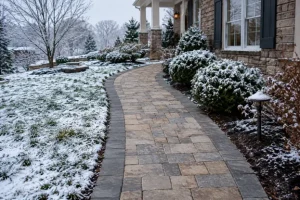
10. Give the Walkway Practical Attention
A refreshed front yard should make the approach to your home easier, not merely more decorative. This practical role should guide landscaping front yard ideas as much as appearance.
Inspect the walkway for loose paving, raised transitions, spreading joints, and vegetation narrowing the route. Note where people repeatedly walk off the path.
If the route is awkward, a future redesign may provide more value than decorative upgrades around it.
For immediate improvement, remove obstacles, trim obstructing growth appropriately, and reposition containers away from turns and landings.
Observe drainage after rain. A low spot or downspout discharging across the path should be addressed before adding expensive finishes.
Where paving or steps require professional repair, complete that work before installing nearby plants that could later be disturbed.
The walkway should remain the organizing connection between parking, garden, and entrance.
11. Update Landscaping Lights for Earlier Evenings
Once Halloween lights come down, the yard may feel unexpectedly dark.
Start by identifying the purpose of each permanent fixture. Steps need visible transitions, the entrance needs clear identification, and a walkway needs enough light to follow comfortably.
Decorative lighting should support those functions rather than overwhelm them.
DarkSky International recommends outdoor lighting that is useful, targeted, no brighter than necessary, controlled, and warm-colored. Shielding and careful aiming help keep light within the intended area.
Use landscaping lights selectively. A few properly placed fixtures can be more comfortable than many exposed bulbs.
Evaluate the arrangement after dark from both directions along the route. Check for glare at seated and standing eye levels, as well as light entering neighboring windows.
12. Choose Warm Lighting and Suitable Controls
Warm lighting can help the entrance feel welcoming without recreating the intensity of a holiday display.
DarkSky’s home-lighting assessment recommends warm or amber-toned fixtures at 2700K or lower for night-friendly lighting. It also recommends timers or motion sensors so lights operate only when needed.
Separate functional and decorative lighting where practical. You may want entrance and access lighting available while garden accents switch off earlier.
Use outdoor-rated equipment and follow manufacturer instructions. New wiring, outlets, and integrated masonry lighting should be handled by qualified professionals.
Avoid leaving temporary Halloween extension-cord arrangements in place as a permanent solution.
The most useful lighting upgrade is not necessarily a brighter bulb. Better placement, shielding, and controls may address the problem more effectively.
13. Be Realistic About Late-Fall Lawn Improvements
After decorations are removed, worn patches may become visible where props, furniture, or foot traffic affected the lawn.
Assess the damage before applying seed. Late-season conditions may not provide enough time for establishment.
University of Maryland Extension advises sowing seed or laying sod no later than mid-October in its maintenance calendar, noting that November killing frosts can damage young seedlings. Sod is somewhat more forgiving but should still establish before freezes.
That means a post-Halloween refresh should not automatically include a full overseeding project.
Focus on removing heavy leaf cover, keeping unnecessary traffic off vulnerable areas, and planning renovation for an appropriate period.
For urgent bare-ground concerns, ask a qualified professional about temporary protection and a site-specific restoration plan.
Choose a Front Yard Style That Fits Your Home
A coherent style makes seasonal updates easier because each new choice follows an established direction.
Style | Main characteristics | Post-Halloween refresh |
Traditional | Defined beds, repeated shrubs, balanced entrance | Coordinated planters and restrained seasonal accents |
Cottage-inspired | Layered planting and informal combinations | Selective cleanup with clear paths and edges |
Modern | Simple forms, limited materials, uncluttered space | Remove excess décor and emphasize structure |
Naturalistic | Site-suited planting and habitat-conscious maintenance | Retain appropriate leaves while clearing access |
Low-maintenance | Simplified beds and manageable plant quantities | Reduce clutter and prioritize durable improvements |
Use these as guiding approaches rather than strict rules.
A small modern porch can connect with a softer planting scheme. A traditional home can incorporate habitat-friendly maintenance.
The important relationship is between architecture, outdoor use, and the amount of maintenance you can realistically sustain. Keeping these factors in mind helps landscaping front yard ideas feel cohesive and manageable.
Create a Practical Refresh Plan
Divide the project into manageable stages.
First Weekend: Clear and Assess
Remove Halloween decorations, clean the entrance, inspect paths, and photograph the yard.
Next Stage: Restore Definition
Tidy bed edges, manage leaves, adjust containers, and correct excess mulch.
Then: Improve Function
Schedule necessary paving, drainage, or lighting work. Address these before installing new planting in affected areas.
Finally: Plan Long-Term Changes
Choose future plants, develop a coordinated material palette, and identify work that should wait for a better seasonal window.
This sequence prevents decorative work from being undone by repairs.
It also gives you time to judge the yard without seasonal distractions before committing to larger purchases.
Common Post-Halloween Landscaping Mistakes
Watch for these frequent missteps:
- Replacing every decoration with another seasonal object.
- Removing every leaf without considering location or use.
- Adding mulch without checking existing depth.
- Buying plants without researching mature size.
- Rushing late-season seeding.
- Installing bright lights without assessing glare.
- Improving appearance while ignoring drainage.
- Planting before nearby construction is finished.
University guidance emphasizes appropriate planting timing, selective leaf management, and avoiding excessive mulch—not simply doing more work as winter approaches.extension.umd+2
A fresh look should come from better decisions and clearer organization, not an increasing maintenance burden.
When to Hire a Landscape Professional
Professional help is valuable when the refresh involves recurring drainage problems, substantial planting changes, walkway reconstruction, or permanent electrical work.
Ask for a site assessment before a shopping list. This helps turn landscaping front yard ideas into a practical plan that fits your property’s needs.
A useful proposal should explain priorities, plant selection, mature spacing, materials, maintenance needs, scheduling, and responsibilities for specialist work.
Request examples of comparable projects and clarify which services are included. Design, installation, hauling, restoration, and follow-up maintenance may be priced separately.
Share how you use the property and how much upkeep you want. The right plan should fit those needs rather than simply reproduce a photograph.
Landscaping Front Yard Ideas for a Fresh Start After Halloween
The best post-Halloween update begins with a clear entrance, organized beds, practical pathways, and a few coordinated details.
Ready to refresh your front yard after Halloween and prepare for the coming winter? Contact Hawkins Landscaping Inc. for professional landscaping services and a customized improvement plan designed around your property, style, and budget. Our team can help identify which upgrades will make the biggest impact now and which planting or construction projects are better suited for spring.
Whether you’re considering a complete landscaping design, refreshed planting beds, attractive landscape borders, improved drainage, or better-positioned landscaping lights, these landscaping front yard ideas can help create a cohesive and inviting entrance. By focusing on practical improvements that work across seasons, you can enhance curb appeal while making your outdoor space easier to maintain.
With over 50 years of experience serving Frederick County and surrounding areas, Hawkins Landscaping Inc. can help turn your landscaping ideas into a functional, attractive outdoor space you can enjoy throughout the year.
Ready to give your front yard a fresh start? Call (301) 898-3615 or visit hawkinslandscaping.com to schedule your consultation. Ask about our flexible financing options for your outdoor project.