Fall lawn care in Frederick, Maryland, should focus on maintaining healthy grass, managing fallen leaves, correcting soil problems, and preparing the property for winter. The right plan from a lawn care service depends on your grass type, lawn condition, and how much growing time remains—not simply the arrival of cooler weather.
For many homeowners, hiring a Frederick lawn service makes seasonal maintenance easier to coordinate. However, a useful service plan should explain what your lawn actually needs rather than automatically including every available treatment.
This guide covers mowing, leaf management, soil testing, fertilization, aeration, watering, and winter preparation. It also explains landscape vs lawn care so you can choose the right services for your property.
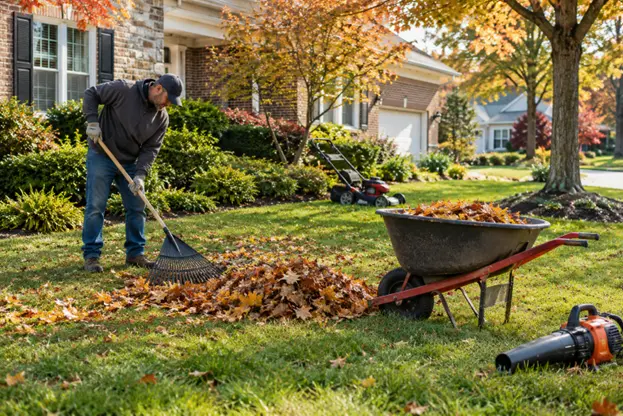
Why a Lawn Care Service Matters for Fall Maintenance in Frederick
Fall is an important maintenance period for Maryland’s cool-season lawns. University of Maryland Extension identifies late summer through early fall as the best time for lawn renovation and overseeding, including aeration and sowing grass seed. It also recommends fall fertilization according to grass type and the state’s lawn-care schedule.
However, “fall lawn care” is not one task performed on one date. Early-season renovation differs from late-October maintenance, and warm-season grasses need a different schedule from cool-season turf.
As winter approaches, priorities shift toward protecting established growth, clearing excessive leaf cover, following fertilizer restrictions, and addressing recurring problems.
A successful lawn care service plan should leave the lawn appropriately maintained—not overloaded with unnecessary products or subjected to rushed work after the ideal treatment window has passed.
Start With a Lawn Assessment
Before booking treatments, walk the property and divide it into areas with different conditions.
Look for thin turf, bare patches, weeds, standing water, heavy shade, worn paths, and places where grass repeatedly struggles. Photograph the lawn after rainfall as well as during dry weather.
Ask whether each problem is new or recurring. A patch damaged by temporary foot traffic may need a different solution from an area beneath dense tree cover.
Identify the grass type if possible. Tall fescue, fine fescue, Kentucky bluegrass, zoysia, and bermudagrass do not share identical maintenance schedules.
University of Maryland Extension provides different fertilizer recommendations for these grasses, including fall applications for common cool-season turf and different timing for warm-season species.
The assessment should guide the service—not the other way around.
1. Test the Soil Before Adding Lime or Nutrients
A soil test is one of the most useful starting points for an effective lawn-care plan. It provides information that visual inspection cannot reliably supply.
University of Maryland Extension recommends testing soil every three years and before a lawn renovation project.
A basic test can identify soil pH and nutrient levels, helping determine whether lime or specific nutrients are appropriate. Maryland’s Department of Agriculture advises ordering a basic test that includes pH, calcium, phosphate, potassium, and magnesium.
Do not apply lime simply because it is fall or because moss appears in the lawn. A treatment should respond to the test results and site conditions.
One important Maryland distinction: the state advises following University of Maryland nitrogen recommendations rather than automatically using a laboratory’s nitrogen recommendation.
Keep the report so you and your lawn care service can compare future decisions against an established baseline.
2. Keep Mowing While the Grass Is Growing
Do not stop mowing because the calendar reaches November. Continue as needed while grass is actively growing, adjusting frequency to actual conditions.
For Maryland home lawns, University of Maryland Extension generally recommends maintaining grass at 3 to 4 inches and mowing more frequently during active spring and fall growth.
Use sharp blades and avoid suddenly cutting an overgrown lawn extremely short. A consistent mowing routine is more useful than a drastic final cut.
The university’s maintenance calendar notes that the last mowing may occur in late November. It also says a final cut approximately half an inch shorter than usual can improve air circulation and reduce conditions favorable to snow mold.
That does not mean scalping the lawn. Confirm the appropriate approach for your grass type and condition.
3. Manage Leaves Without Automatically Removing Everything
Leaves are useful organic material, but thick accumulations should not remain matted across the lawn.
You have several options: collect leaves, move them into suitable garden areas, compost them, or shred manageable amounts with a mulching mower.
University of Maryland Extension explains that leaves can be retained intact elsewhere in the yard for wildlife habitat. On lawns, shredding can speed decomposition and return organic material to the soil.
For mulching, work when leaves are dry and distribute the chopped material so it filters through the grass rather than smothering it.
A property with several mature trees may need repeated visits instead of one end-of-season cleanup.
Ask your lawn care service whether the plan includes mulching, collection, hauling, or relocating leaves. Those are different services with different outcomes.
4. Follow Maryland’s Lawn Fertilizer Rules
Fall fertilization requires careful timing and attention to what the lawn actually needs.
University of Maryland Extension states that homeowners may not apply nitrogen lawn fertilizer between November 15 and March 1. Its commercial guidance describes a limited professional application window between November 15 and December 1, subject to specific nitrogen-rate and product restrictions.
Do not assume hiring a contractor removes seasonal limits. Ask the provider to explain the proposed product, application rate, timing, and legal basis.
A late-season application is not automatically necessary if the lawn has already received an appropriate amount of fertilizer.
The university notes that some healthy, established lawns may need only one nitrogen application annually, depending on grass type and conditions.
Keep application records to avoid duplicate treatments from overlapping services.
5. Do Not Buy “Winterizer” Based on the Label Alone
A product marketed as winterizer is not a complete lawn-care plan. The important questions concern its nutrients, application rate, suitability, and timing.
Ask what the product supplies and why those nutrients are needed. A lawn should not receive phosphorus simply because a bag is labeled for fall use.
University of Maryland Extension advises choosing a zero-phosphorus lawn fertilizer unless soil-test results indicate a need, subject to applicable Maryland requirements and exceptions.
Organic fertilizer is not automatically exempt from the rules. The same university guidance discusses Maryland’s requirements in the context of organic lawn management.
When comparing estimates, request the treatment details rather than accepting a generic “winter feeding” description.
A smaller, targeted program may be more appropriate than several overlapping applications.
6. Aerate Only When the Lawn Needs It
Core aeration removes plugs of soil from the lawn. It can be useful where compaction affects turf performance, but it should not be added to every fall package without assessment.
Look at heavily used areas, routes traveled by equipment, and places where the soil surface appears compacted. Drainage and turf condition should also be evaluated.
University of Maryland Extension recommends fall aeration for cool-season turf such as tall fescue, while warm-season turf such as zoysia follows a different seasonal schedule.
Timing matters. Late summer and early fall are the preferred renovation period for Maryland lawns; waiting until very late in the season can limit the benefit of combining aeration with seed establishment.
Ask your lawn care service why aeration is recommended now and what result to expect.
7. Be Realistic About Late-Fall Overseeding
Overseeding can improve thin turf, but spreading seed does not guarantee successful establishment.
Seed selection, soil contact, moisture, temperature, and remaining growing time all affect the outcome. A lawn seeded during an appropriate renovation window has different prospects from one seeded shortly before winter.
University of Maryland Extension identifies late summer through early fall as the best period for Maryland lawn renovation and overseeding.
By late October, ask for a site-specific assessment rather than assuming the ideal window remains open.
If conditions are unsuitable, focus on leaf management, soil testing, drainage evaluation, and planning the next appropriate renovation period.
Also investigate why the lawn is thin. Repeated seeding will not necessarily solve dense shade, persistent waterlogging, unsuitable grass selection, or constant wear.
8. Water According to Conditions
Cooler weather does not eliminate the need to assess soil moisture, particularly where grass has recently been seeded.
New seeding needs a different watering approach from an established lawn. Follow establishment guidance rather than applying a fixed schedule across the entire property.
University of Maryland Extension emphasizes continued care after seeding, including appropriate watering, mowing, and follow-up fertilization within Maryland’s seasonal restrictions.
Watch the weather and the soil. Avoid watering simply because an irrigation controller is still set to its summer program.
If water is repeatedly running off, collecting in low areas, or leaving the lawn saturated, investigate the cause before increasing irrigation.
For in-ground systems, arrange any necessary seasonal shutdown according to the equipment and local conditions. Clarify whether irrigation service is included in your lawn-care agreement.
9. Investigate Drainage and Repeated Wear
Some lawn problems need more than mowing and fertilizer.
After rainfall, identify puddles, concentrated downspout discharge, eroded edges, and routes where people repeatedly cross wet grass. These observations can help distinguish a turf-management problem from a broader site issue.
A contractor may recommend changes to water routing, grading, or circulation, depending on the property. Ask where redirected water will go and whether additional professional assessment is needed.
Likewise, an area that serves as a daily shortcut may be better suited to a properly designed path than repeated reseeding.
Avoid committing to construction without understanding the cause. A drain, retaining edge, or new walkway should be part of a coordinated plan.
This is where lawn care and landscaping often overlap.
Landscape vs Lawn Care: What Is the Difference?
Understanding landscape vs lawn care helps you compare proposals accurately, especially when evaluating a lawn care service alongside broader landscaping work.
Lawn care focuses primarily on turf health and maintenance. Landscaping addresses the wider outdoor environment, including planting design, garden beds, trees, circulation, grading, and other features.
Some companies provide both, but the services should still be identified separately.
Service | Lawn-care scope | Broader landscaping scope |
Mowing and edging | Regular turf maintenance | Coordination with beds and paved areas |
Fertilization | Lawn nutrient management | Plant-specific care where offered |
Aeration and overseeding | Turf improvement | Coordination with renovation plans |
Leaf management | Protecting lawn surfaces | Garden-bed and property-wide cleanup |
Drainage assessment | Identifying effects on turf | Site improvements or specialist coordination |
Planting | Usually limited or separate | Trees, shrubs, perennials, and design |
Walkways and patios | Generally outside basic lawn care | Hardscape planning and installation |
Ask who performs specialist work and whether subcontractors are involved.
A complete property plan can be useful, but you should not pay for services that do not address your priorities.
Build a Practical Fall Maintenance Schedule
Use a flexible schedule based on grass type, weather, and the condition of the property.
Late Summer Through Early Fall
Assess the lawn, obtain soil-test information, and plan any appropriate renovation. This is the preferred period for Maryland overseeding and related renovation work.
October
Continue mowing as needed, manage falling leaves, care for new grass, and review any remaining fertilizer needs against previous applications.
Early November
Complete appropriate homeowner fertilizer applications before the November 15 cutoff, and continue monitoring leaf cover and grass growth.
Late Fall
Keep essential routes and lawn surfaces clear, mow if growth continues, and document problems for future work. Do not assume the lawn needs another treatment simply because winter is approaching.
Weather can shift individual tasks. A calendar should guide decisions, not replace observation.
Common Fall Lawn-Care Mistakes
Several mistakes can undermine an otherwise sensible maintenance program:
- Applying lime without soil-test support.
- Fertilizing without checking previous applications.
- Treating cool-season and warm-season grasses identically.
- Waiting too long to evaluate a renovation project.
- Leaving thick leaf mats across the lawn.
- Cutting the grass drastically short.
- Overseeding without correcting recurring site problems.
- Buying a package without understanding its scope.
University of Maryland’s guidance consistently emphasizes soil testing, appropriate mowing, grass-specific fertilizer schedules, and correctly timed renovation rather than a universal treatment program.
A good contractor should be able to explain which services are unnecessary as clearly as those that are recommended.
How to Choose a Lawn Care Service in Frederick
Look for a provider that asks about your grass type, previous treatments, maintenance goals, and recurring problems before recommending a package.
Request a written scope covering:
- Mowing frequency and height.
- Edging and cleanup.
- Leaf mulching, collection, or hauling.
- Soil sampling and interpretation.
- Fertilizer products and timing.
- Aeration and seeding recommendations.
- Weed-management services, if included.
- Site protection and access.
- Weather-related scheduling.
- Follow-up visits and exclusions.
Verify applicable qualifications, insurance, and credentials for regulated services. Ask who will apply fertilizer or pesticides and how treatments will be documented.
Compare equivalent services rather than monthly prices alone. One proposal may include repeated leaf visits and disposal, while another covers mowing only.
Budget for the Most Useful Work First
If your budget is limited, begin with necessary maintenance and diagnosis.
Keep excessive leaves off the turf, mow appropriately, and obtain a soil test when due. Then decide whether targeted treatments or future renovation are justified.
Do not assume a larger package produces a healthier lawn. Several unnecessary services can cost more without correcting the actual problem.
Ask the contractor to separate immediate maintenance from optional improvements and longer-term landscaping.
For example, correcting a recurring access problem may be a separate project from restoring the surrounding grass. Phasing the work can help prevent paying for seeding that will later be disturbed by construction.
Your Pre-Winter Lawn Checklist
Before winter, confirm that you have:
- Identified the grass type and major problem areas.
- Reviewed the most recent soil-test results.
- Recorded fertilizer applications.
- Followed applicable seasonal restrictions.
- Continued mowing according to growth.
- Managed leaves without leaving heavy mats.
- Evaluated moisture and drainage concerns.
- Protected recently established grass.
- Clarified irrigation shutdown responsibilities.
- Planned any deferred renovation work.
Keep photographs and service records together. They make it easier to evaluate changes and communicate with your provider next season.
Get Your Lawn Ready for Winter With a Frederick Lawn Care Service
The best fall lawn-care plan is specific to your property. It combines appropriate mowing, sensible leaf management, soil-based decisions, and treatments timed for your grass and Maryland’s requirements.
Ready to prepare your yard for winter and get a head start on spring? Contact Hawkins Landscaping Inc. for professional landscaping services tailored to your property’s seasonal needs. Our team can help assess your outdoor spaces, prioritize essential maintenance tasks, and recommend practical improvements based on your yard’s condition.
When comparing Frederick lawn care service options, it’s important to understand the difference between landscape vs. lawn care. Lawn care focuses on maintaining healthy grass through services such as mowing, aeration, and overseeding, while landscaping can include planting beds, drainage solutions, walkways, patios, and other outdoor improvements. Understanding these needs can help you choose the right services for your property.
With over 50 years of experience serving Frederick County and surrounding areas, Hawkins Landscaping Inc. can help you prepare your yard for winter while planning for a healthier, more attractive outdoor space in the growing season ahead.
Ready to plan your seasonal landscaping needs? Call (301) 898-3615 or visit hawkinslandscaping.com to schedule your consultation. Ask about our flexible financing options for your outdoor project.